















How Groundwater Extraction Systems Work in India
Groundwater meets nearly two-thirds of India's irrigation needs and most of its rural drinking water supply. Yet few people understand what actually happens between an aquifer deep underground and the water reaching a tap or irrigation channel.
As India's annual groundwater extraction touches 245.64 billion cubic meters (BCM), the systems responsible for accessing, lifting, and distributing this water have become critical infrastructure. This article breaks down exactly how groundwater extraction systems work, the technologies involved, and why efficient, well-regulated extraction matters more than ever.
What is a Groundwater Extraction System?
A groundwater extraction system is a structured arrangement of wells, pumps, pipes, and associated equipment used to withdraw water stored beneath the earth's surface from aquifers and deliver it for various applications. These systems play a crucial role in ensuring a reliable water supply in regions where surface water sources such as rivers, lakes, and reservoirs are insufficient or unavailable.
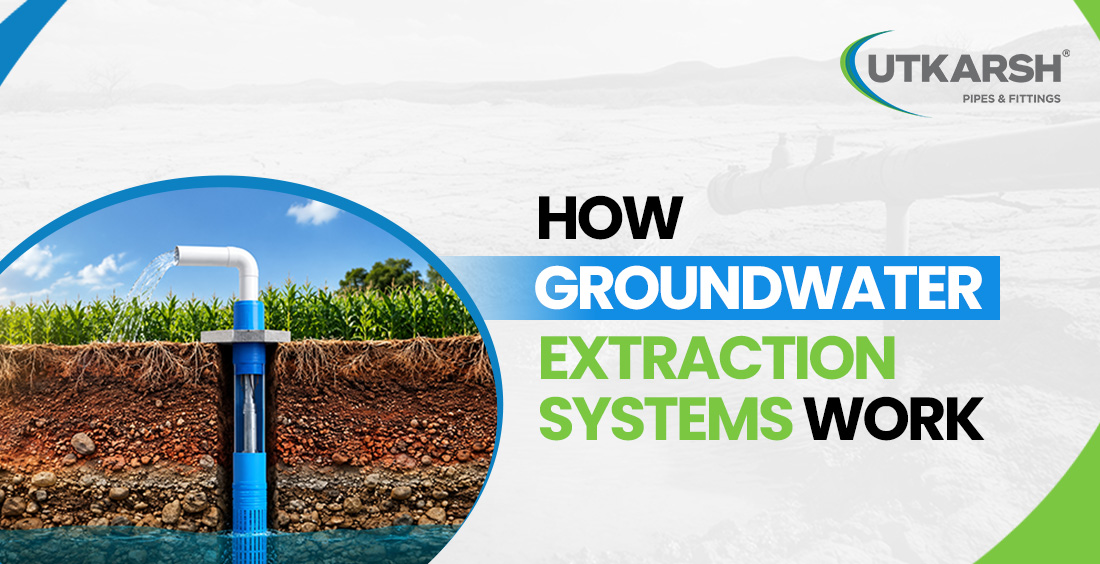
A well-designed groundwater extraction system depends on the coordinated performance of several components working together: the well or borehole structure, a casing pipe to keep it from collapsing, a well screen, a pump, and the delivery and storage infrastructure that gets water to where it's needed.
How Groundwater Extraction Works, Step by Step
1. Hydrogeological Survey and Site Assessment
Before any drilling begins, engineers conduct a hydrogeological survey to identify where groundwater is likely to be found, at what depth, and in what quantity. This involves:
Geophysical resistivity surveys to map subsurface rock layers
Analysis of existing borewell data in the region
Study of aquifer type (unconfined, confined, or perched)
Assessment of the water table depth and seasonal fluctuation
Agencies like the Central Ground Water Board (CGWB) maintain extensive aquifer mapping data through the National Aquifer Mapping (NAQUIM) programme, which has identified around 25 lakh square kilometres of India as mappable area, with the government reporting this coverage as largely complete.
2. Drilling and Borewell Construction
Once a viable site is identified, drilling begins using one of several methods depending on soil type and depth requirements:
Rotary drilling: Common in soft, alluvial formations, using a rotating drill bit with drilling fluid (mud or air) to remove cuttings
Percussion drilling: Suited to softer, unconsolidated formations, working by repeated impact rather than rotation
Down-the-hole (DTH) hammer drilling: Preferred for hard rock areas, since its percussive action fractures rock more efficiently than rotation alone, giving faster, straighter boreholes
After drilling, a casing pipe (typically PVC or MS) is inserted to prevent the borewell walls from collapsing, followed by a slotted or perforated pipe section at the water-bearing zone that allows water to enter while filtering out sediment.
3. Pump Installation
This is where extraction actually happens. The type of pump used depends on the depth of the water table and the intended use:
Submersible pumps: Installed directly inside the borewell below the water level, ideal for deep aquifers and continuous operation
Centrifugal (surface) pumps: Used where the water table is shallow, typically within 7 to 8 metres
Solar-powered pumps: Increasingly adopted for agricultural use, reducing dependence on grid electricity
Hand pumps: Still widely used in rural and low-infrastructure settings for drinking water access
The pump lifts water through a riser pipe to the surface, where it is either used directly, stored in overhead tanks, or fed into a distribution network. As pumping draws water out, the level inside the well temporarily falls, a process called drawdown, before recovering once pumping stops. A well's sustainable yield is the pumping rate the surrounding aquifer can replenish without a long-term decline in water level.
4. Water Distribution and Storage Infrastructure
Extracted groundwater rarely goes straight to the end user. Instead, it typically passes through:
Overhead or ground-level storage tanks that balance supply and demand
Treatment units, where required, for filtration and disinfection
Pipeline networks that carry water to households, farms, or industrial units
Pressure-boosting systems in areas with elevation changes or long-distance supply
5. Monitoring and Regulation
Sustainable groundwater extraction systems are not "set and forget." They require ongoing monitoring through:
Piezometers and water-level sensors that track aquifer depletion in real time
Metering systems that measure actual extraction volumes
Compliance checks against state and central groundwater regulations
India currently operates a network of roughly 25,000 groundwater level monitoring stations under CGWB's National Hydrograph Network, combining open dug wells and piezometers, with an increasing number fitted with telemetry-based Digital Water Level Recorders for real-time tracking.
Is Groundwater Extraction Regulated in India?
Digging a borewell isn't a free-for-all, even on your own land. The Central Ground Water Authority (CGWA), along with state groundwater departments, regulates extraction to prevent overexploitation:
Notified and over-exploited areas often require an explicit No Objection Certificate (NOC) before a new borewell can be sunk, and the authority can restrict or decline new extraction depending on local conditions.
Industries, infrastructure, and mining projects generally need a CGWA NOC, applied for online, with exemptions for very small users, such as micro and small enterprises drawing under 10 cubic metres a day.
Individual farmers drawing groundwater for irrigation are generally exempt from NOC requirements, as are small domestic users with low-capacity pumps.
Unauthorised extraction where an NOC is required can attract penalties and Environmental Compensation under the Environment (Protection) Act, 1986.
Requirements vary by state and change periodically, so anyone planning a borewell for commercial, industrial, or bulk use should confirm current thresholds with CGWA or their state groundwater authority before drilling, rather than relying on older figures found online.
Is Extracted Groundwater Safe to Use?
Not automatically. Groundwater quality varies significantly by region, and contamination is often invisible without testing. According to CGWB data, fluoride beyond permissible limits has been found in isolated pockets across 370 districts in 23 states, and arsenic in 152 districts across 21 states, with nitrate contamination from agricultural runoff and sewage now affecting groundwater in more than half of India's districts.
For drinking and domestic use, water should be tested against the Bureau of Indian Standards' IS 10500:2012 specification, which sets acceptable and permissible limits for physical, chemical, and bacteriological parameters. For irrigation or industrial use, the relevant parameters differ, and testing requirements are typically lighter, but salinity and specific contaminants can still affect crops or equipment over time.
The practical takeaway: a well-built extraction system gets water out of the ground efficiently, but it says nothing about whether that water is safe to drink without treatment. That's a separate question, answered by testing, not by the quality of the borewell itself.
Groundwater Abstraction Methods: 5 Types of Wells Compared
Dug wells are the oldest and simplest method: large-diameter, shallow, and often excavated by hand. They're inexpensive but more exposed to contamination and seasonal water-table swings than drilled alternatives.
Tube wells and borewells are frequently used interchangeably in everyday conversation, and in practice they overlap considerably. Where a distinction is drawn, tube well tends to describe narrower installations in softer, alluvial ground reaching moderate depths, while borewell more often refers to a machine-drilled hole reaching deeper, harder-rock formations with a casing pipe and screen fitted throughout. Both rely on a pump rather than manual lifting, which is what separates them from dug wells.
Deep wells push further still, into aquifers hundreds of metres down, and need high-capacity submersible pumps and casing rated for the added hydraulic pressure. They're built for industrial and large-scale agricultural loads that shallower wells can't sustain.
Collector wells (radial wells) work differently altogether: a central vertical shaft connects to horizontal collector pipes radiating into the surrounding aquifer, drawing from a wide area at once. This spreads the drawdown across more of the aquifer, which is why municipal supply projects and riverbank filtration systems favour them.
Also read: Best Borewell Pipes for Borewell Projects
Key Components of a Groundwater Pumping System
A quick recap of the pieces covered above, and what each one is responsible for:
Borewell or well structure: the drilled or dug access point into the aquifer
Casing pipe (PVC or MS): stabilises the borehole wall and keeps surrounding soil or rock from collapsing in
Well screen: slotted or perforated section at the water-bearing zone, lets water in while filtering out sand and sediment
Submersible or surface pump: does the actual lifting, sized and positioned according to depth and demand (see Step 3)
Rising main pipe: carries water from the pump to the surface, and needs to withstand hydraulic pressure and water-hammer effects as well as the pump's own weight
Power supply and control system: electricity and automation that keeps the pump running safely, including protection against dry-running
Storage and distribution network: tanks and pipelines that hold and move water to where it's used (see Step 4)
Of these, the casing pipe and the well screen do the most to determine how long a system lasts. A poorly chosen casing pipe can crack under pressure, let sediment in, or corrode over time, all of which shorten a system's working life regardless of how good the pump is.
Conclusion
Every part of a groundwater extraction system depends on the others: a strong pump can't compensate for a casing pipe that fails, and a well-built casing means little if the screen lets sediment through. Whether the setup is a dug well, tube well, borewell, or deep well, the quality of the underlying components determines how long it lasts and how reliably it performs.