














Top 10 Applications of PVC Pipes You Should Know
Look behind the walls of almost any modern building, under any irrigated field or inside any borewell in India, and you will find PVC pipes doing the work. PVC pipe now spans homes, farms, factories and public infrastructure, making it one of the most widely used piping materials in the country.
What makes PVC so versatile? It is light yet strong; it does not rust or corrode, it resists most chemicals, and its smooth inner surface keeps water flowing freely for decades. Add lower installation costs and a long service life, and it is easy to see why engineers, contractors, farmers and homeowners keep choosing it.
But not every PVC pipe suits every job. Each application calls for a specific type, pressure class and standard. This guide covers the 10 most important applications of PVC pipes, what each one demands, and which pipe type fits best.
Key Takeaways
- PVC pipes are used in plumbing, drainage, irrigation, borewells, construction, industry and public water supply.
- uPVC suits cold water and pressure lines, CPVC handles hot water and chemicals, and SWR pipes are built for drainage.
- Each application has its own Indian Standard, such as IS 4985 for water supply and IS 15778 for CPVC.
- Choosing the right pipe type and pressure class matters as much as choosing PVC itself.
Why PVC Pipes Are Used Almost Everywhere
Before looking at the applications, here is what PVC brings to every project:
- Corrosion resistance: No rust, no scaling, no loss of flow over time.
- Lightweight handling: Easier transport and faster installation with less labour.
- Chemical resistance: Stands up to soil, fertilisers, wastewater and many industrial fluids.
- Smooth bore: Low friction means better flow and lower pumping costs.
- Long service life: 50 years or more with correct installation.
- Cost efficiency: Lower material, installation and maintenance costs than metal pipes.
These properties are the reason PVC appears in every one of the applications below.
Top 10 Applications of PVC Pipes
1. Residential Plumbing and Drinking Water Supply
Home plumbing is the most common answer to the question "where are PVC pipes used?" uPVC pipes carry cold water from overhead tanks to taps, bathrooms and kitchens, while CPVC pipes handle hot water from geysers and mixed hot and cold lines.
Why PVC fits: It keeps water clean with no rust, resists scale build up and is certified for potable use when made to IS 4985 (uPVC) or IS 15778 (CPVC).
Best pipe: uPVC for cold water, CPVC for hot water. Explore Utkarsh's uPVC plumbing pipes and fittings.
2. Drainage and Sewage Systems
Among all PVC pipe uses in plumbing and drainage, SWR (soil, waste and rainwater) pipes play a critical role. They carry wastewater from toilets, kitchens and bathrooms, along with rainwater from roofs, to the main sewer or drain.
Why PVC fits: Smooth inner walls reduce clogging, leak proof joints protect hygiene, and the material resists the chemicals found in household and commercial waste.
Best pipe: SWR pipes and fittings made to IS 13592.
3. Agricultural Water Supply
PVC pipes for agriculture form the main water lines that carry water from pumps, canals and borewells to fields. They are buried underground or laid across farmland to move large volumes of water efficiently.
Why PVC fits: Resistance to soil chemicals and fertilisers, easy handling across large areas, and low water loss through tight joints.
Best pipe: uPVC agriculture pressure pipes in the right pressure class for the pump and terrain. See Utkarsh's agriculture pipes and fittings.
4. Drip and Sprinkler Irrigation
PVC pipes for irrigation are the backbone of modern drip and sprinkler systems. They serve as main and sub main lines that feed laterals, drippers and sprinkler heads, helping farmers deliver water exactly where crops need it.
Why PVC fits: Consistent pressure across the system, minimal leakage and a long service life in outdoor conditions, especially with UV-stabilised grades.
Best pipe: uPVC pressure pipes for mains and sub mains. To understand how pipe choice affects water use on the farm, read how pipe selection impacts irrigation efficiency.
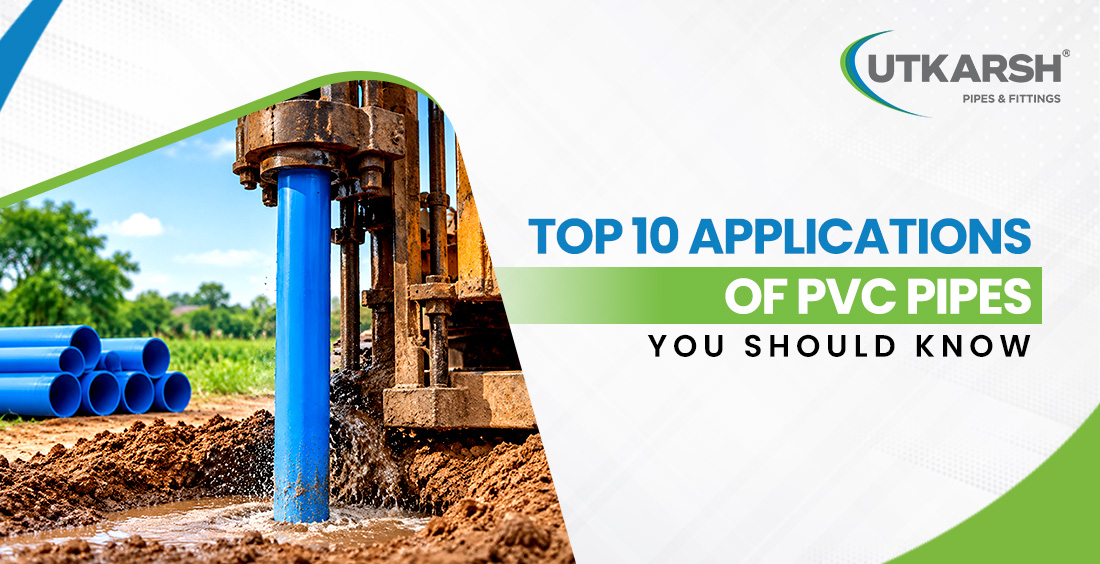
5. Borewell Casing
PVC casing pipes line the borewell after drilling. They hold back soil and rock, prevent the bore from collapsing, and stop surface contaminants from entering the groundwater.
Why PVC fits: It does not corrode in wet, mineral rich or acidic soil, keeping the water clean and the borewell stable for years.
Best pipe: PVC casing pipes made to IS 12818, in plain or ribbed variants, chosen by depth and soil type.
6. Submersible Pump Column Pipes
Column pipes, also called riser pipes, connect the submersible pump at the bottom of a borewell to the surface. They carry the weight of the pump and the water column while delivering water upward under pressure.
Why PVC fits: High tensile strength, threaded leak-proof joints and corrosion resistance, at a fraction of the weight of GI pipes.
Best pipe: uPVC column riser pipes rated for the borewell depth and pump weight.
7. Building Construction and Rainwater Harvesting
The uses of PVC pipes in construction go far beyond indoor plumbing. Builders use them for rainwater downpipes, roof drainage, rainwater harvesting systems, sleeves through walls and slabs, and service lines in residential and commercial projects.
Why PVC fits: Fast installation that keeps construction schedules on track, weather resistance and low lifetime maintenance.
Best pipe: SWR pipes for rainwater and drainage, uPVC for water supply lines.
8. Industrial Fluid Handling
PVC pipe applications in industries include carrying process water, cooling water, chemicals and effluents in factories, treatment plants and processing units.
Why PVC fits: CPVC in particular offers strong resistance to many acids, alkalis and salts, along with higher temperature tolerance, up to around 93°C.
Best pipe: CPVC for hot or chemically aggressive fluids, uPVC for cold process water. Always check chemical compatibility with the manufacturer before installation. See Utkarsh's CPVC pipes and fittings.
9. Electrical and Cable Protection
PVC conduits protect electrical wiring inside walls, ceilings and floors. In larger networks, plastic ducts protect underground power, telecom and fibre optic cables.
Why PVC fits: PVC is a natural electrical insulator, resists moisture and corrosion, and is easy to cut, bend and route.
Best pipe: PVC conduits for building wiring. For underground telecom and fibre networks, PLB HDPE ducts are the preferred choice.
10. Municipal and Rural Water Supply
Large-scale water distribution networks in towns and villages use PVC pipes to carry treated water from storage reservoirs to neighbourhoods and individual household connections. Programs that expand household tap connections across rural India rely heavily on plastic piping.
Why PVC fits: Long service life, low leakage, easy installation in remote areas and lower project costs.
Best pipe: uPVC pressure pipes made to IS 4985 for distribution lines, alongside HDPE for long transmission mains.
Also read: What are PVC Pipes? Uses, Benefits, and Applications Explained
How to Choose the Right PVC Pipe for Your Application
- Identify what the pipe will carry: cold water, hot water, wastewater or chemicals.
- Check the pressure: pump fed, high rise and irrigation lines need the right pressure class.
- Confirm the standard: look for the ISI mark and the correct IS number printed on the pipe.
- Consider the environment: use UV-stabilised pipes for long term outdoor exposure.
- Match the fittings: use fittings and solvent cement made for the same pipe type.
- Buy from a certified PVC pipe manufacturer: consistent quality across every batch matters as much as the pipe type.
Why Utkarsh Pipes & Fittings Is the PVC Pipe Manufacturer to Trust
- More than 50 years in the pipes and fittings industry, serving homes, farms, industries and infrastructure projects across India.
- Products made to Indian Standards, including IS 4985, IS 15778, IS 13592 and IS 12818, and tested through 5X quality checks for durability, leak proof performance, non-toxicity, pressure resistance and strength.
- BIS-certified product lines, recognition from EEPC India and FIEO, and a complete range covering plumbing, drainage, agriculture, borewell and industrial needs.
- Two manufacturing plants with around 68,000 metric tonnes of annual capacity, backed by 150,000+ plumbing partners and 5,000+ dealers nationwide.
Whatever your application, Utkarsh Pipes and Fittings, a trusted PVC pipe manufacturer, has a certified pipe built for the job. Contact the Utkarsh team today to find the right solution for your project.
Wrapping Up
From the tap in your kitchen to the borewell on a farm and the drainage line under a city street, PVC pipes support almost every part of modern water management. The key is matching the application with the right pipe: uPVC for cold water and pressure lines, CPVC for hot water and industrial fluids, SWR for drainage and casing pipes for borewells. Get that match right, and your system will deliver reliable performance for decades.
Frequently Asked Questions
What are the most common PVC pipe uses?
The most common uses are home plumbing, drinking water supply, drainage and sewage, agricultural irrigation, borewell casing, submersible pump lines, construction, industrial fluid handling and electrical conduits.
Where are PVC pipes used in construction?
In construction, PVC pipes are used for water supply lines, drainage and sewage, rainwater downpipes, rainwater harvesting systems and electrical conduits.
Which PVC pipe is best for agriculture?
uPVC agriculture pressure pipes are best for farm water supply and irrigation mains, as they resist soil chemicals and fertilisers and handle pump pressure reliably.
Can PVC pipes be used for hot water?
Standard uPVC pipes are for cold water only. For hot water, use CPVC pipes, which can handle temperatures up to around 93°C.
Are PVC pipes suitable for industrial use?
Yes. CPVC and uPVC pipes are used for process water, cooling water and many chemical lines. Chemical compatibility should always be confirmed for the specific fluid.
How long do PVC pipes last?
With correct installation and use within their rated conditions, PVC pipes typically last 50 years or more.
What is the difference between SWR and uPVC pressure pipes?
SWR pipes are designed for non-pressure drainage of soil, waste and rainwater. uPVC pressure pipes are designed to carry water under pressure for supply and irrigation.