















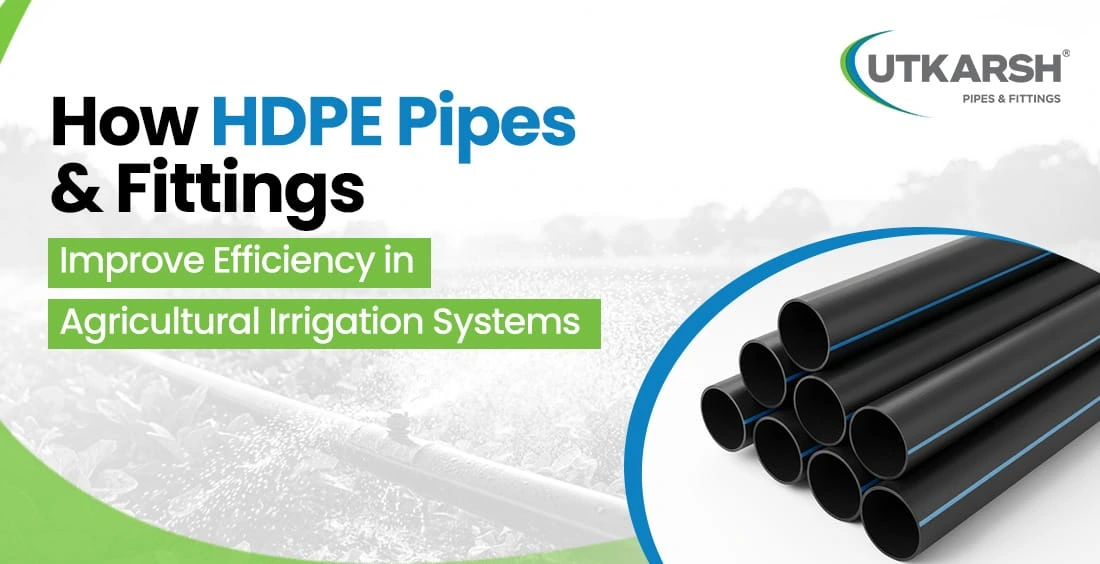
How HDPE Pipes & Fittings Improve Efficiency in Agricultural Irrigation Systems
Water is the ultimate lifeline of agriculture. For a country’s farming sector to thrive, water must reach crops at the right time, in the right quantity, and with zero wastage. However, traditional piping networks made of metal, clay, or concrete often fall short due to leakage, corrosion, and high maintenance costs.
To tackle these challenges, modern farming is rapidly shifting toward advanced piping solutions. High-Density Polyethylene (HDPE) systems have emerged as the gold standard for transforming farm productivity. Below, we explore how integrating HDPE pipes & fittings optimizes water delivery, lowers energy costs, and ensures long-term sustainability for farmers.
1. Consistent, Leak-Proof Water Supply
A primary requirement for any modern irrigation setup is delivering water efficiently without precious loss. Traditional piping joints are notoriously prone to cracking and weeping over time. In contrast, HDPE pipes for irrigation are joined using heat fusion techniques (like butt welding and electrofusion). This creates a continuous, homogenous, and completely leak-proof system where the joint becomes as strong as—or stronger than—the pipe itself. No leaks mean maximum water conservation, ensuring every drop reaches the roots.
2. Low Friction for Maximum Flow & Energy Savings
The inner architecture of a pipe dictates how hard your pumps have to work. When evaluating HDPE pipe specifications, one of the standout features is an exceptionally smooth interior surface. This ultra-smooth wall minimizes frictional drag and turbulence. As a result:
Water flows at higher velocities and consistent pressure.
The load on water pumps drops significantly, leading to lower electricity or diesel consumption.
The risk of internal sediment buildup, scaling, and clogging is entirely eliminated.
3. Ultimate Flexibility for Rough Terrains
Agricultural lands are rarely perfectly flat; they are often marked by slopes, uneven contours, obstacles, and shifting soil structures. Thanks to the inherent elasticity of high-density polyethene, hdpe agriculture pipelines can bend and curve naturally around landscape contours. This flexibility drastically cuts down the requirement for directional fittings like elbows or couplers, making installation highly cost-effective and structurally resilient against soil movement or seismic shifts.
4. High Resistance to Rust, Corrosion, and Chemicals
Modern farming involves the regular use of water mixed with fertilizers, pesticides, and weedicides (fertigation). Traditional metal pipes degrade, rust, and scale rapidly when exposed to these agricultural chemicals. An HDPE pipe for water supply boasts superb chemical inertness. It resists corrosive soils, harsh chemicals, acids, and alkalis, ensuring that the pipeline remains completely intact for decades without leaching toxic elements into the soil.
5. Lightweight Design with Simple Maintenance
Compared to heavy, rigid concrete or cast-iron pipes, HDPE is remarkably lightweight. This drastically reduces transportation overheads and eliminates the need for heavy, expensive machinery during deployment. A small crew of technicians or farmers can easily uncoil, align, and install long runs of HDPE piping, lowering labour costs and installation timelines.
6. Superior High-Pressure Handling Capability
Modern irrigation systems, especially sprinkler and drip networks, require pipes that can withstand continuous pressure variations while maintaining consistent water flow. HDPE pipes for irrigation are designed with specific pressure ratings (PN ratings) that enable them to handle high internal pressure without cracking, leaking, or losing performance over time.
Their flexibility also helps absorb sudden pressure surges, reducing the risk of damage caused by water hammer. This combination of strength and resilience makes HDPE an ideal solution for demanding agricultural applications. Farmers looking to understand the technology behind this durability can explore how HDPE Pipes are designed to Withstand High-Pressure Applications.
Also Read: HDPE Pipe Specifications: Sizes, Pressure Ratings & Material
Why Utkarsh Pipes and Fittings is the Ideal Partner for Your Farm
When investing in the future of your fields, material quality cannot be compromised. Utkarsh India Limited is a premier manufacturer delivering high-grade HDPE pipes & fittings specifically engineered to endure demanding agricultural environments.
Why Choose Utkarsh Pipes and Fittings?
Premium Virgin Raw Material: Manufactured from top-tier, food-grade virgin PE resin, ensuring maximum tensile strength and longevity.
UV-Stabilized Lifespan: Utkarsh HDPE pipes are formulated with high-quality UV stabilizers, making them perfect for above-ground farm layouts exposed to intense sunlight and weathering.
Rigorous Testing Standards: Every batch undergoes stringent quality checks to match national and international standards, offering a reliable service life extending beyond 50 years.
Comprehensive Range: From varying diameters tailored for main water supply lines to optimized pressure ratings for micro-drip and sprinkler networks, Utkarsh offers customized irrigation ecosystems under one roof.
Upgrade your agricultural output and secure a maintenance-free water network by trusting the proven durability of Utkarsh Pipes and Fittings.
Frequently Asked Questions:
Q1: What makes HDPE pipes better than PVC pipes for agricultural irrigation?
While PVC pipes are rigid and suitable for straight underground tracks, HDPE pipes offer exceptional flexibility, high impact resistance, and completely leak-proof heat-fused joints. This allows HDPE to adapt to uneven terrains and resist cracking from ground movement or heavy farm machinery.
Q2: Can Utkarsh HDPE pipes handle high-pressure sprinkler systems?
Yes. Utkarsh HDPE pipes are manufactured in various pressure ratings (PN ratings) and wall thickness. You can easily choose high-pressure variants perfectly calibrated for sprinkler or drip irrigation systems.
Q3: Does extreme sunlight degrade HDPE agriculture pipes?
Standard plastic degrades under sunlight, but Utkarsh HDPE pipes are specially UV-stabilized. This prevents brittleness and thermal cracking, ensuring exceptional performance even in open, sun-drenched fields.
Q4: Is the water transported via HDPE pipes safe for organic farming?
Absolutely. HDPE is a non-toxic, chemically inert polymer. An Utkarsh hdpe pipe for water supply does not rust, corrode, or leach chemicals, ensuring that clean, unpolluted water is delivered directly to your crops.