















How Water Scarcity Is Driving Demand for Modern Storage and Distribution Systems
Turn on a tap today, and you cannot always be sure water will come out. In the summer of 2019, Chennai's four main reservoirs ran dry within weeks of each other. Bengaluru residents now book water tankers the way they book cabs. This is not a distant problem. It is a daily reality for millions of people.
The numbers back up what people feel on the ground. NITI Aayog's Composite Water Management Index, close to 600 million Indians face high to extreme water stress, and nearly two lakh people die every year from inadequate access to safe water.
The same report projects that by 2030, India's water demand will be twice the available supply, a gap that could shave off close to 6% of the country's GDP.
Twenty-one major Indian cities, including Delhi, Bengaluru, and Chennai, have been flagged in past government assessments as facing severe groundwater depletion, though the specific city-by-city projections behind that claim have since been debated by researchers.
If this trend continues unchecked, entire cities will face longer dry spells, costlier water tankers, and rationed supply as a permanent way of life, not an occasional summer inconvenience. Industries could see production halts, and farmers could lose entire harvest cycles to failed irrigation.
The good news is that the crisis has a fix, and it starts with how we store and distribute water. Sturdy piping networks and reliable storage tanks are what stand between a household or a factory and a dry tap, and building this infrastructure the right way is now central to India's water security conversation.
Overall, the research points to the root cause of water scarcity in India as not a single issue, but a combination of factors: over-extracted groundwater, inefficient agricultural practices, severe pollution, and the pressure of a rapidly growing population.
Why India's Water Crisis Is a Combination Problem, Not a Single One
Groundwater has quietly become India's default backup source, and it is running out faster than it can recharge. The Central Ground Water Board has repeatedly flagged large parts of Punjab, Haryana, Rajasthan, and Tamil Nadu as "over-exploited," meaning more water is drawn out each year than rainfall and natural processes put back in.
Agriculture makes this worse. Indian farming still consumes roughly 80 percent of the country's freshwater, much of it through flood irrigation methods that lose a large share to evaporation and runoff before it ever reaches a crop's roots.
Then there is pollution. Untreated sewage and industrial effluent regularly find their way into rivers and lakes, turning already scarce water into water that is unsafe to use without extensive treatment. Add rapid urbanisation and a population still growing every year, and the demand curve keeps climbing while the supply curve stays flat or drops.
The Solution Starts With Strong Piping Networks and Storage Tanks
Fixing groundwater depletion, farming practices, and pollution all at once is a decades-long national project. But there is one lever that homes, businesses, and industries can pull right now: building water infrastructure that stores every drop efficiently and moves it without loss.
A leaking, corroded, or undersized pipe network can waste a shocking share of treated water before it ever reaches a tap. Municipal water audits in Indian cities have found non-revenue water losses (water that is treated and pumped but never billed or used) running as high as 40% to 50% in some networks, largely due to old pipelines and poor storage.
This is where the basics matter more than any high-tech gadget. A well-designed water storage tank, paired with a corrosion-resistant piping network, closes this gap in three ways:
It holds water in reserve for dry days, tanker delays, or scheduled municipal cuts.
It protects stored water from contamination, algae, and bacterial growth, so nothing is wasted through spoilage.
It moves water efficiently from rooftop to sump to tap, with minimal leakage along the way.
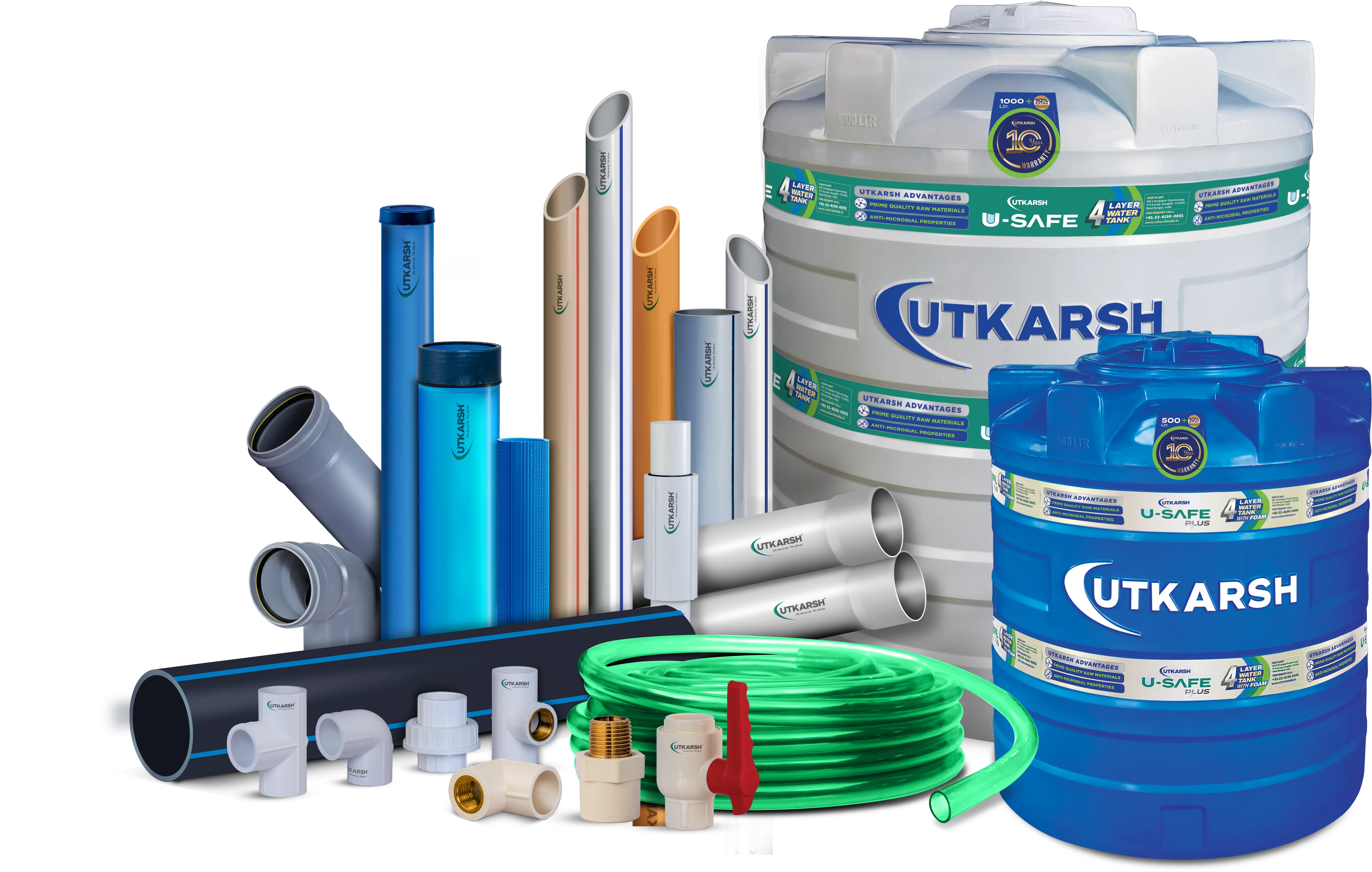
Utkarsh Pipes & Fittings builds exactly this kind of infrastructure. Its water storage tanks are made from 100% virgin, food-grade polyethylene with a six-shoulder design for superior compressive strength, and they resist UV damage, fungus, algae, and corrosion across every layer.
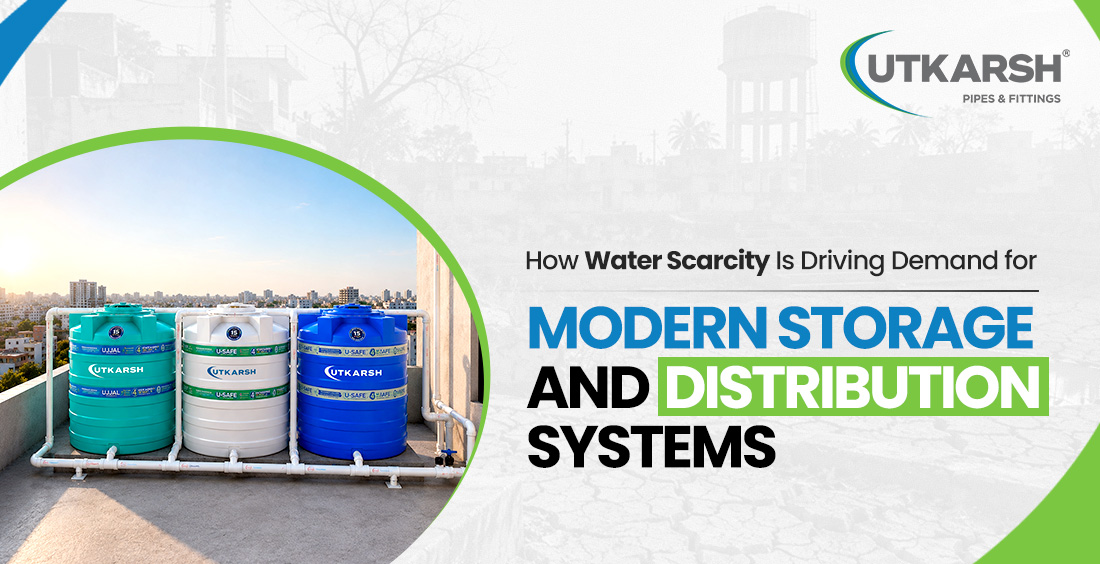
The tanks come in 2-layer, 3-layer (Ujjal), 4-layer (U-Safe), and 4-layer insulated foam (U-Safe+) variants, each tested to IS 12701:1996 and backed by a 10-year warranty. Paired with the brand's HDPE and uPVC pipe ranges, this forms a distribution system built to carry water reliably from source to storage to use, whether that is a home rooftop tank or an industrial reservoir.
Also Read: How to Choose the Right Water Storage Tank for Home or Industrial Use
Modern Technology and Sustainable Practices for Every Setting
Good infrastructure is the foundation, but small daily habits and smart technology multiply its impact. Here is how homes, commercial spaces, and industries can each do their part.
For Homes: Small Habits, Big Savings
Rooftop rainwater harvesting into the sump: Rooftops act as natural catchment areas. A simple network of gutters and downpipes can channel monsoon rain from the roof through a first-flush diverter (to filter out dust and debris) into an underground sump or storage tank, cutting dependence on borewells and tankers for months.
Recharge the ground, not just the tank: Once the storage tank is full, excess rooftop water can be redirected into a recharge pit or borewell, letting it percolate back into the soil instead of running off into drains. This is one of the simplest ways an individual household can help reverse local groundwater depletion.
Reuse RO rejects water: Most homes with an RO purifier throw away nearly as much water as they filter. That reject water is not for sewage. It is safe for watering plants, mopping floors, washing the car, or flushing toilets. Keeping a bucket under the RO outlet is a five-minute habit that can save hundreds of litres a month.
Choose tanks built for hygiene, and the right size: A tank with anti-microbial, anti-algae layers means stored water stays usable for longer without frequent cleaning or wastage. Right-sizing matters too: undersized tanks waste pumping energy on frequent refills, while oversized ones risk water stagnation. Use this Water Tank Capacity Calculation guide to size it correctly.
For Commercial Spaces: Efficiency at Scale
Greywater recycling for non-potable use: Offices, malls, and hotels generate large volumes of greywater from wash basins and kitchens. Treating and reusing this for flushing, gardening, or cooling towers can cut freshwater intake significantly.
Smart, sensor-enabled storage tanks: IoT-based water level sensors and leak-detection alerts help facility managers spot overflow, wastage, or pipe damage before it turns into a major loss, especially useful across large, multi-tank commercial setups.
Rooftop harvesting linked to a central storage network: Commercial buildings with large roof areas can capture significant rainwater volumes each monsoon. Routed into a properly sized storage tank and distribution network, this becomes a real supplementary source rather than runoff.
Water-efficient fixtures: Low-flow taps, sensor-based faucets, and dual-flush systems reduce daily consumption without any change in user experience.
For Industry: Closing the Loop
Zero Liquid Discharge (ZLD) systems: Manufacturing units are increasingly required, and incentivised, to treat and recycle processed water on-site rather than discharging it, reducing both freshwater intake and pollution load on rivers.
Large-capacity, corrosion-resistant storage tanks: Industrial processes often need a buffer of clean water on standby for cooling, cleaning, or emergencies. Tanks built for heavy-duty, continuous use, resistant to chemical exposure and structural stress, keep operations running without interruption.
HDPE piping networks for long-distance distribution: Industries moving water across large campuses benefit from HDPE pipes, which resist corrosion, handle high pressure, and have a long service life compared to older metal piping, cutting both leakage and maintenance costs.
SCADA-based monitoring: Automated monitoring systems track flow rates, pressure, and tank levels in real time across an industrial site, flagging inefficiencies before they become expensive problems.
Where Water Storage Tanks Fit Into the Bigger Picture
Every one of these practices, rainwater harvesting, greywater reuse, groundwater recharge, or industrial water recycling, depends on one shared piece of infrastructure: somewhere reliable to store the water once it is collected or treated. This is why water storage tanks sit at the centre of any serious water conservation plan, whether it is a single household or a large industrial facility. Without dependable storage, harvested rainwater has nowhere to go, and recycled greywater cannot be held for reuse.
Utkarsh Pipes: Built for Modern, Sustainable Water Management
Utkarsh Pipes & Fittings' water tank range and piping systems are engineered with exactly this future in mind. Every tank is manufactured using 100% virgin, food-grade material and tested against IS 12701:1996, the Bureau of Indian Standards BIS specification for rotationally moulded polyethylene water storage tanks, alongside relevant international benchmarks.
The six-shoulder design, anti-microbial protection, and UV resistance are not just marketing points. They are what let a household or an industry rely on stored water for years without contamination or structural failure. Combined with the brand's corrosion-resistant piping range, Utkarsh Pipes products are genuinely aligned with modern technology and sustainable water management practices, built to support India's shift from reactive water crisis management to proactive conservation.
Ready to Build a Water-Secure Home or Facility?
Whether you need a compact 500L tank for a home rooftop, an insulated 1000L U-Safe+ for extreme climates, or a full HDPE piping network for an industrial site, Utkarsh Pipes & Fittings has a solution engineered for reliability. Explore the full range of piping solutions today, and take the first step toward a water-secure tomorrow.
Frequently Asked Questions
1. Why is water scarcity such a big issue in India right now?
India is dealing with over-extracted groundwater, inefficient agricultural water use, and pollution of surface water sources, all while population and urban demand keep growing. NITI Aayog projects that by 2030, water demand will be twice the available supply if current trends continue.
2. Can rainwater harvesting actually make a difference at home?
Yes. A rooftop harvesting setup channels monsoon rain into a storage tank or recharge pit instead of letting it run off into drains. Over a full monsoon season, this can meaningfully reduce dependence on borewells and tanker water, while also helping replenish local groundwater.
3. Is RO reject water safe to reuse?
Yes. RO reject water is not contaminated, it simply has a higher mineral concentration than the filtered water. It is perfectly safe for watering plants, mopping, washing vehicles, or flushing toilets, and reusing it avoids sending clean water straight down the drain.
4. What makes a water storage tank suitable for long-term use?
Look for 100% virgin food-grade material, UV resistance, anti-microbial and anti-algae protection, a multi-layer wall structure, and certification to IS 12701:1996. These features prevent contamination, structural degradation, and frequent replacement.
5. How can industries reduce their water footprint?
Industries can adopt zero liquid discharge systems to treat and reuse process water, install large-capacity corrosion-resistant storage tanks, use HDPE piping for efficient distribution, and monitor consumption with automated systems to catch leaks and inefficiencies early.