















Overhead Water Tank vs Underground Water Tank: Which Is Better?
If you're planning a new build or replacing an old tank, you'll hit this question sooner or later: should the water go on the roof or under the ground? Both an overhead tank and an underground water tank store the same water, but they get it there in very different ways, and the right pick depends on your building, your budget, and how much backup supply you actually need.
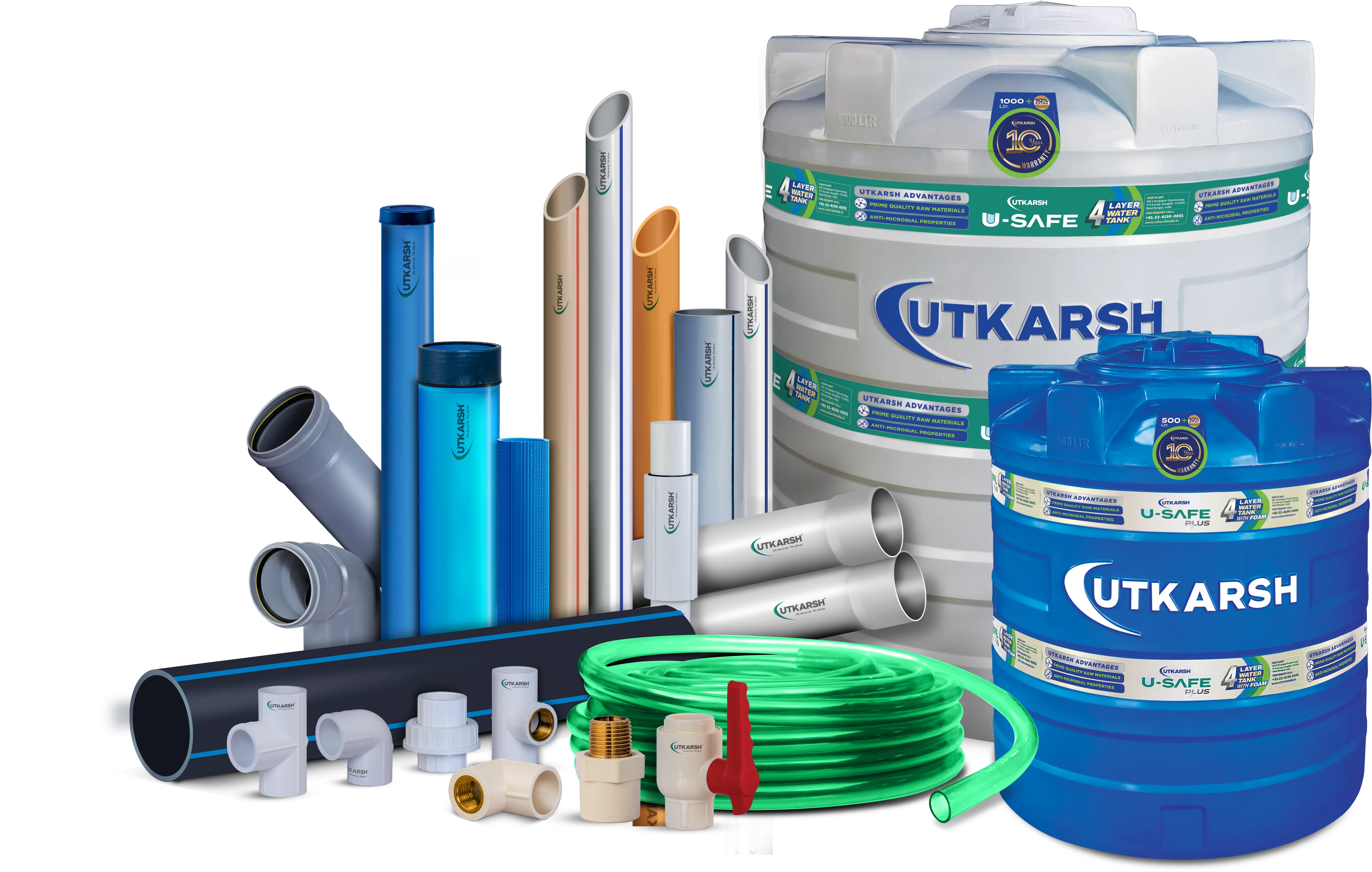
At Utkarsh Pipes & Fittings, our water storage tank range is built around overhead tanks engineered for strength and hygiene, used across homes, apartments, and commercial buildings (explore the range). Most Indian homes end up using an underground sump alongside an overhead tank rather than choosing one over the other, so this guide walks through both: what each one does well, where it falls short, and how to size and combine them.
What Is an Overhead Water Tank?
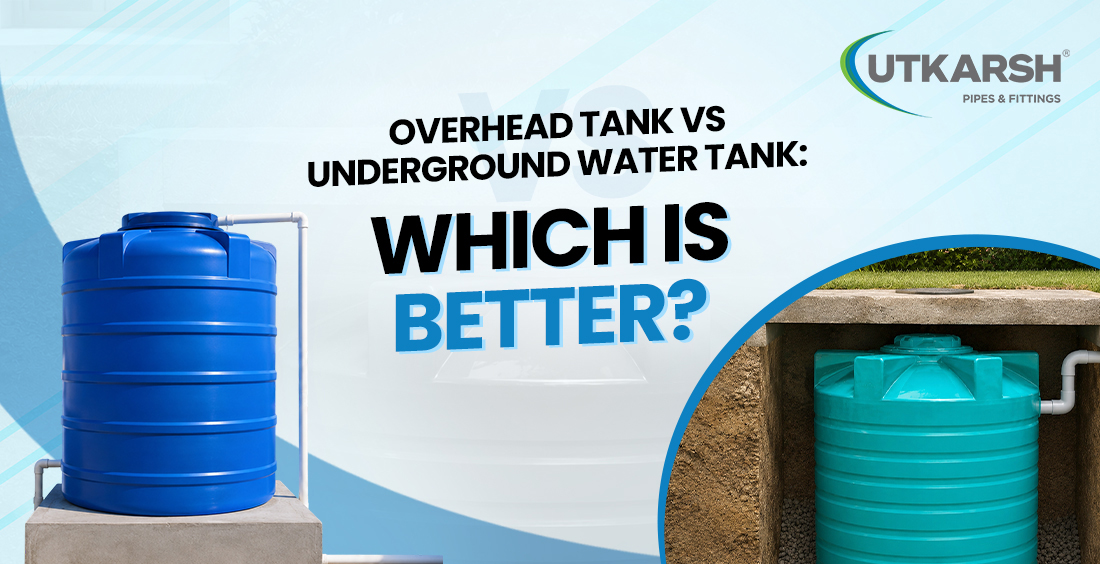
An overhead water tank is installed at an elevated position, typically on a rooftop, terrace, or an elevated platform. Water is pumped up into the tank and then flows down to taps and fixtures using gravity, which means you don't need a motor running every time you turn on a tap.
Advantages of Overhead Water Tanks
Overhead tanks remain a preferred choice for residential, commercial, and industrial buildings because of the following benefits:
Gravity-fed water pressure: Since water flows downward naturally, overhead tanks provide consistent water pressure across multiple floors without needing a constant power supply.
High storage capacity: Overhead tanks are built to hold large volumes of water, ensuring an uninterrupted supply even during municipal water cuts.
Strong structural durability: Utkarsh overhead water tanks feature a six-shoulder design that improves compressive strength, along with a multi-ribbed body for long-lasting performance.
Weather-resistant construction: These tanks are 100% UV-protected, which prevents material degradation from constant sun exposure on rooftops.
Easy leak detection and maintenance: Since the tank is visible and accessible, spotting leaks, cracks, or cleaning requirements is far simpler than with a buried tank.
Simple installation: Overhead tanks don't require excavation, making them quicker and less labour-intensive to install.
Overhead tanks are especially well-suited for multi-storey residential buildings, apartment complexes, and commercial establishments where consistent water pressure across floors is a priority.
What is an Underground Water Tank?
An underground water tank, as the name suggests, is installed below ground level, either fully buried or partially sunk into a pit. Water is drawn out using a pump and then supplied directly to the building or pumped up into an overhead tank for further distribution.
Underground Water Storage Solutions: Key Benefits
Space-saving installation: Since the tank sits below ground, it doesn't take up rooftop or terrace space, making it ideal for plots with limited open area.
Protection from environmental exposure: Being underground shields the tank from direct sunlight, heavy winds, and temperature extremes.
Reduced water temperature fluctuations: Water stored underground stays cooler in summer and doesn't freeze in winter compared to exposed overhead tanks.
Concealed and secure storage: Underground tanks are less visible, which works well for properties that want an unobtrusive water storage solution.
Large-scale storage capability: Underground tanks are commonly used as the primary sump or reservoir that feeds water to overhead tanks in bigger residential and commercial projects.
Underground tanks are a practical fit for independent houses, villas, and larger properties that have available ground space and want to keep water reserves cool and protected from the elements.
Overhead Water Tank vs Underground Water Tank: Feature Comparison
Cost figures above are indicative only. Actual pricing varies by city, brand, capacity, and site conditions, so treat this as a starting point for budgeting rather than a quote.
How Much Water Tank Capacity Do You Need?
A useful starting point is the domestic water supply benchmark set by the Bureau of Indian Standards (IS 1172) and adopted by the CPHEEO: roughly 135 litres per person per day. Working from that figure:
A family of 3–4 uses around 400–540 litres a day, so a 500–750 litre tank covers roughly a day's backup.
A family of 5–6 uses around 675–810 litres a day, which typically calls for a 1,000 litre tank or a smaller tank refilled more often.
Independent houses and larger properties usually pair a 750–1,000 litre overhead tank with a bigger underground sump that acts as the main reserve, especially where municipal supply is irregular.
Utkarsh's overhead tanks are available in 500, 750, and 1,000 litre capacities across all three product lines, so most households can match a tank to their daily usage without needing to combine multiple units.
Water Tank Guide Points to Keep in Mind
Whether you choose an overhead tank, an underground tank, or both, proper installation directly affects the tank's lifespan and water quality. Keep these points in mind:
Choose a stable, level surface to prevent tilting or structural stress, especially for overhead tanks placed on rooftops.
Use a strong base, such as reinforced concrete, to support the tank's weight once filled.
Keep the tank shaded where possible to reduce UV exposure and temperature-related degradation.
Use food-grade pipes and fittings for inlet and outlet connections to avoid contaminating drinking water.
Ensure proper ventilation so the tank doesn't develop pressure issues.
Install the tank with a certified plumber or technician to avoid fitting errors that could lead to leaks.
Check overflow outlets regularly to prevent water wastage or flooding around the base.
Following these steps ensures your water storage tank performs reliably for years, regardless of whether it's installed overhead or underground.
Also Read: How to Choose the Right Water Storage Tank for Home or Industrial Use
Which One Should You Choose?
There's no single right answer here. It comes down to three things: your property type, your water supply pattern, and how much space you can spare.
If you live in a multi-storey building and need steady water pressure on every floor without relying on a pump each time, an overhead water tank is the better fit.
If you have ground space to spare and want to protect your water reserve from heat, contamination, and visual clutter, an underground water tank works well.
For most independent homes and larger residential or commercial projects, using both together, an underground tank as the primary reservoir and an overhead tank for daily gravity-fed distribution, is the most efficient and widely recommended residential water storage system.
Why Choose Utkarsh Pipes & Fittings for Your Water Storage Tanks
Utkarsh Pipes & Fittings manufactures overhead water storage tanks engineered using 100% virgin, food-grade materials, available in three product lines to match different budgets and climate needs:
UJJAL (3-Layer Water Tank): a durable, straightforward option built with the six-shoulder design and multi-ribbed body described above.
U-SAFE (4-Layer Water Tank): adds an extra protective layer for added strength on top of the same anti-fungal, anti-microbial construction.
U-SAFE PLUS (4-Layer Water Tank with Foam): includes an insulating foam layer that keeps stored water cooler during peak summer heat, plus an inner layer infused with Microban antibacterial technology that eliminates up to 99.9% of bacteria.
All three lines are available in 500, 750, and 1,000 litre capacities, come with a 10-year warranty and 10% extra storage over the rated size, and are tested against Indian and international standards. Explore the full Utkarsh water tank range to compare capacities and find the right fit for your home.
Conclusion
Both overhead and underground water tanks have a clear role to play in residential water storage systems, and neither is universally better. Overhead tanks win on gravity-fed pressure and easy maintenance, while underground tanks win on space efficiency and protection from weather extremes. The right choice comes down to your building type, available space, water pressure needs, and budget, and often, the smartest setup uses both together for a dependable, uninterrupted water supply.
With Utkarsh Pipes & Fittings' range of durable, hygienic, and warranty-backed water tanks, you get reliable storage solutions built to last, whichever option you choose.
FAQs
1. Which lasts longer, an overhead tank or an underground water tank?
Both can last for many years when installed and maintained correctly. Underground tanks are more protected from UV exposure and weather extremes, while overhead tanks like Utkarsh's are 100% UV-protected and built with a six-shoulder design for long-term durability, so lifespan depends more on tank quality and maintenance than on placement alone.
2. Is an underground water tank safe for drinking water storage?
Yes, as long as the tank is made from food-grade material, properly sealed, and regularly cleaned.
3. Do I need both an overhead and an underground tank for my house?
For independent houses and larger properties, using an underground tank as the main reservoir along with an overhead tank for daily distribution is a common and efficient setup. It ensures a large water reserve while still providing gravity-fed pressure to taps and fixtures.
4. How often should a water storage tank be cleaned?
It's recommended to clean and inspect your water tank every six months, regardless of whether it's overhead or underground, to prevent sediment buildup, algae growth, and contamination.
5. Which is cheaper, an overhead or underground water tank?
An overhead plastic tank is almost always the cheaper option to install. A 500–1,000 litre plastic overhead tank typically costs somewhere in the ₹2,500–₹8,000 range plus basic installation, while an underground RCC tank involves excavation, waterproofing, and concrete work, which usually pushes the cost into the tens of thousands of rupees even for a similar capacity. Exact costs vary by city, labour rates, and site conditions, so it's worth getting a local quote before budgeting.
6. What size water tank do I need for my family?
A useful starting point is the Bureau of Indian Standards/CPHEEO benchmark of 135 litres per person per day for domestic use. For a family of 4, that works out to roughly 540 litres a day, so a 750–1,000 litre overhead tank gives a comfortable one to two-day buffer. Larger households, or homes without a dependable municipal supply, often pair that overhead tank with a bigger underground sump for extra reserve.