













Designing a Plumbing System with UPVC Pipes: Best Practices
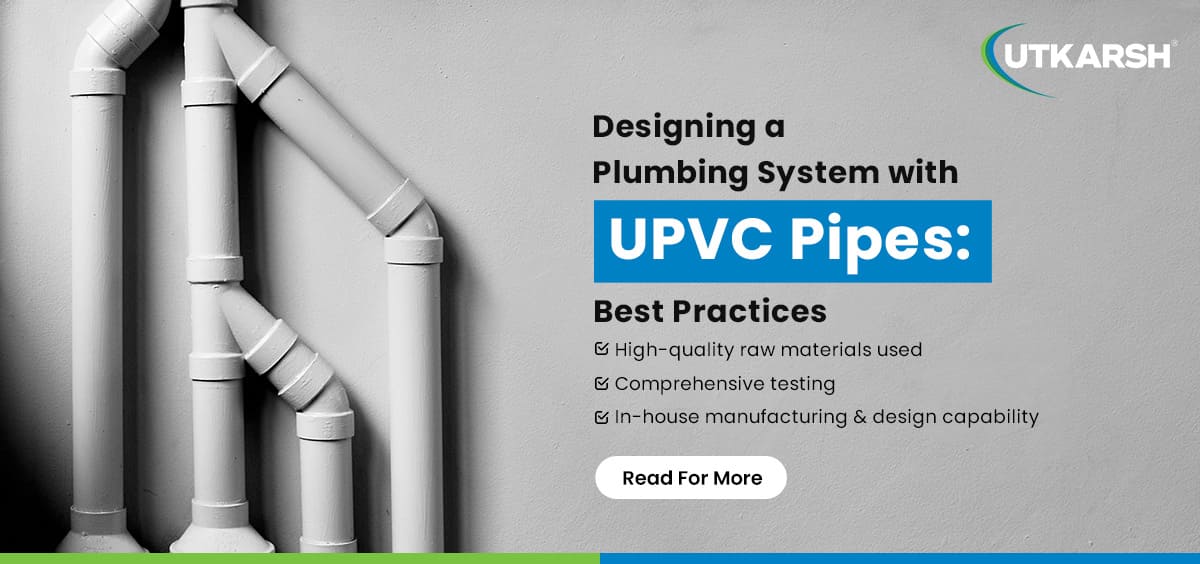
A well-designed plumbing system keeps water moving reliably through a home, office or factory, and it keeps repair bills low for years. Most of that reliability is decided at the drawing stage: which material you choose, how you size each line, how you join and support the pipes, and how you test them before the walls are closed.
uPVC (unplasticised polyvinyl chloride) pipes have become a common choice for cold-water supply lines because they resist corrosion, install quickly and carry water efficiently. As a uPVC pipe manufacturer, Utkarsh Pipes makes its uFLO pipes and fittings for exactly these applications. This guide walks through the practical design decisions behind a dependable uPVC cold-water network.
A note on scope: this guide covers pressurised water-supply lines. Soil, waste and rainwater lines work by gravity and need a product built for drainage, such as SWR pipes and fittings.
Why uPVC Pipes Are Ideal for Plumbing Systems
1. Superior Durability and Corrosion Resistance
uPVC pipes don't rust, scale or react with the water they carry. Unlike galvanised iron, the bore doesn't narrow over the years as corrosion builds up, so the flow you design for is the flow you keep getting.
2. Lightweight and Easy to Install
The light weight of uPVC pipes makes handling, transport and installation easier. That cuts labour time and speeds up project completion, especially in complex plumbing layouts.
3. Smooth Flow and High Efficiency
uPVC pipes have a smooth internal surface that keeps friction low. Less friction means steadier pressure at the outlets and less work for any pump feeding the system.
4. Cost-Effective and Low Maintenance
uPVC pipes offer good value thanks to their long service life and modest upkeep. Low maintenance isn't the same as no maintenance, though. A few simple periodic checks, covered later in this guide, stop small issues from turning into leaks.
Also Read: Manufacturing Processes That Ensure Strength in uPVC Pipes and Fittings
Best Practices for Designing a Plumbing System with uPVC Pipes
To get the best performance and lifespan from a uPVC plumbing system, follow these design and installation practices.
1. Accurate Pipe Sizing and System Planning
Pipe size decides how much water reaches each outlet and at what pressure. Start from demand: count the fixtures each line serves, estimate how many will run at the same time, and note how water enters the building. Many Indian homes run on gravity feed from an overhead tank, where the available pressure is low, so an undersized line quickly shows up as weak flow at upper-floor or far-end taps.
As a rough illustration for a typical house fed from an overhead tank:
- ½ inch (15 mm) branches to individual taps, basins and cisterns
- ¾ inch (20 mm) lines to a bathroom or kitchen group
- 1 inch (25 mm) or larger for the main down-take from the tank feeding several bathrooms
Treat these as starting points, not final sizes. Final sizing should be worked out from flow demand, pipe length and the number of fittings, following the water-supply provisions of the National Building Code of India 2016 (Part 9, Plumbing Services) or the advice of a qualified plumbing designer. If an existing building already has pressure complaints, our guide to common causes of water pressure problems in buildings covers the usual culprits.
2. Hot and Cold Line Separation
uPVC is a cold-water material. PVC's pressure capacity falls as temperature rises, and at its maximum service temperature of about 60°C it keeps only around a fifth of the pressure rating it has at 23°C, according to Engineering ToolBox's PVC pressure data. That's why uFLO uPVC pipes and fittings are intended for cold-water lines in houses and buildings.
For geyser outlets, solar water heater lines and any other hot-water run, use CPVC pipes and fittings instead. Utkarsh CPVC pipes are made to ASTM D2846 and IS 15778, standards written for hot- and cold-water distribution. Plan the two networks separately from the start, mark them clearly on the drawings, and keep uPVC away from heater outlets.
3. Pressure Class Selection: Schedule 40 vs Schedule 80
uFLO pipes follow ASTM D1785, the standard that defines Schedule 40 and Schedule 80 PVC pipe. Both schedules share the same outside diameter, so they take the same fittings, but Schedule 80 has a thicker wall and a higher pressure rating.
| Nominal size | Schedule 40 rating at 23°C | Schedule 80 rating at 23°C |
|---|---|---|
| 1 inch | 450 psi (about 31.6 kg/cm²) | 630 psi (about 44.3 kg/cm²) |
| 2 inch | 280 psi (about 19.7 kg/cm²) | 400 psi (about 28.1 kg/cm²) |
Typical published values for ASTM D1785 pipe carrying water. Ratings vary with the PVC compound and the manufacturer, so always check the rating marked on the pipe itself.
In practice, Schedule 40 comfortably handles the low pressures of an overhead-tank system. Choose Schedule 80 for pumped or pressurised lines, for exposed runs where knocks are likely, and wherever you need threaded joints. Only Schedule 80 or heavier pipe should be threaded, and threading cuts the pipe's pressure rating by half.
4. Professional Installation and Jointing
Most leaks in a uPVC system start at a joint, so jointing deserves the most care on site. Installation should be handled by trained plumbers who follow the method suited to each joint type.
Solvent-cement (socket) joints: cut the pipe square, remove burrs and chamfer the edge, then dry-fit to confirm the pipe enters the socket part of the way before meeting resistance. Apply a thin coat of uPVC solvent cement inside the socket and a full, even coat on the pipe, push the pipe home with a quarter turn, hold it for a few seconds and wipe off the excess. Leave the joint undisturbed and let it cure fully before pressurising, which under normal conditions takes around 24 hours.
Threaded joints: use them only on Schedule 80 pipe and fittings. Seal threads with PTFE tape rather than oil-based pastes, which can attack PVC. Tighten by hand and then add one or two turns with a strap wrench, because over-tightening can split female fittings.
Keep the layout simple as well. Use proper elbows and bends rather than heating and bending the pipe, and avoid unnecessary changes of direction, each of which adds friction loss.
5. Pipe Support and Clamp Spacing
uPVC is far more flexible than steel, so horizontal runs need regular support to stop them sagging. For ½ to 2 inch pipe carrying cold water, horizontal supports typically sit about 1.2 to 2 m apart, with smaller sizes at the closer end of that range. Vertical runs can generally be supported at roughly twice the horizontal interval. Always check the manufacturer's support table for exact figures.
Support valves and heavy fittings separately so their weight doesn't hang off the pipe. Use clamps with broad, smooth contact surfaces, and don't clamp the pipe tightly. It needs to slide slightly through the clamp as it expands and contracts.
6. Thermal Expansion Allowance
uPVC expands by about 0.054 mm per metre for every 1°C rise in temperature. That sounds tiny, but a 10 m exposed terrace run that warms by 20°C between a cool morning and afternoon sun grows by roughly 11 mm. If that movement is restrained, the stress ends up at joints and fittings.
Expansion matters most on exposed outdoor runs, since concealed lines inside walls see far smaller temperature swings. On long exposed runs, build in room to move using offsets, changes of direction or expansion loops, and keep clamps loose enough for the pipe to slide.
7. Pressure Testing Before Concealment
Test every line before it disappears behind tiles or plaster. Finding a weeping joint at this stage takes minutes. Finding it after tiling means breaking walls.
- Wait until all solvent-cement joints have fully cured, around 24 hours in normal conditions and longer in cold weather.
- Fill the system slowly with water from the lowest point and bleed out trapped air at the high points.
- Raise the pressure to about 1.5 times the working pressure, which is common site practice, but never above the rating of the weakest component in the line, such as a valve or threaded fitting.
- Hold the test pressure for the period your project specifies, often two hours or more on building sites, and check for any pressure drop or damp joints.
- Test with water only. Never use compressed air or gas on plastic pipe, because a failure under air pressure can be violent.
Photograph the tested lines before they are concealed. Those photos make any future repair much easier to locate.
8. High-Quality Fittings
A plumbing system performs only as well as its weakest connection. Choosing products from trusted uPVC pipe fittings manufacturers gives you strong, leak-proof joints and long-term durability. Match the fitting schedule to the pipe, and use pipes and fittings from the same system so socket dimensions and tolerances line up.
9. Regular Inspection and Maintenance
Routine checks for leaks, joint condition and physical damage catch problems early. On sections exposed to direct sun, also look for discolouration, chalking or brittleness, and add a protective coat of water-based paint or a cover if a run is permanently exposed. Preventive checks like these keep the system efficient and avoid costly repairs.
Reliable uPVC Pipes and Fittings from Utkarsh Pipes
Utkarsh Pipes and Fittings, the polymer division of Utkarsh India Limited, is an established pipe manufacturing company with more than 50 years in the business. Its uFLO uPVC pipes and fittings are made at the company's plant in Gurap, Hooghly, West Bengal, backed by a polymer production capacity of 68,000 MT per annum and a six-stage quality check.
uFLO uPVC Pipes and Fittings: Key Features
- High strength and excellent chemical resistance
- UV-resistant formulation for better performance on exposed runs
- Smooth inner surface for better flow efficiency
- Durable construction for extended service life
- Designed for cold-water plumbing in homes, buildings and industrial process lines
Product Range
uPVC Pipes:
- Sizes from 15 mm to 150 mm (½ inch to 6 inch)
- Push-in pipe variants
- Compliant with ASTM D1785 Schedule 40 and Schedule 80
uPVC Fittings:
- Includes couplers, equal tees, reducing tees and end caps
- Available in threaded and push-in formats
- Sizes from 15 mm to 50 mm (½ inch to 2 inch)
- Conforming to ASTM D2467 Schedule 80
These products suit residential plumbing, cold-water distribution in buildings and industrial process lines. For current rates, see the latest Utkarsh Pipes price list.
Conclusion
A uPVC plumbing system performs reliably for the long term when the design work is done properly. Size lines from real demand, keep hot water on CPVC, pick the right schedule, make clean joints, support the pipe and allow for expansion, and pressure-test before anything is concealed.
For homeowners and contractors looking for a dependable uPVC pipe manufacturer, the uFLO range covers uPVC pipes from 15 mm to 150 mm with matching fittings, made for exactly this kind of cold-water network. For a broader look at a home's full layout, including drainage, read our guide to plumbing system design basics for residential buildings.
Frequently Asked Questions (FAQs)
1. Why are uPVC pipes preferred for plumbing systems?
uPVC pipes are corrosion-resistant, lightweight, durable and cost-effective, which makes them a long-lasting and efficient choice for cold-water plumbing systems.
2. How long do uPVC pipes last?
A well-installed uPVC cold-water system can serve for several decades. Actual service life depends on operating pressure, water temperature, sunlight exposure and the quality of jointing and support during installation.
3. Can uPVC pipes be used for hot water?
No. uPVC is meant for cold-water lines because its pressure capacity drops sharply as temperature rises. Hot-water lines from geysers and solar heaters should use CPVC pipes and fittings.
4. What factors should be considered while designing a uPVC plumbing system?
Key factors include flow demand and pipe sizing, the water source and available pressure, Schedule 40 or Schedule 80 selection, the jointing method, support spacing, allowance for thermal expansion, separation of hot and cold lines, and pressure testing before concealment.