















HDPE vs Ductile Iron Pipes: Which Is Better for Water Infrastructure?
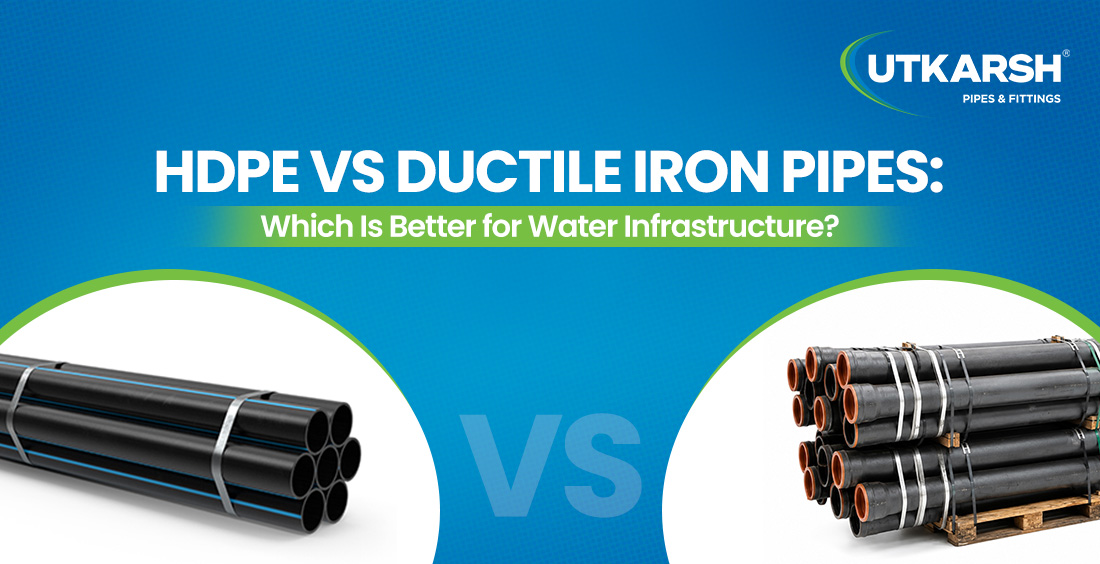
Every water infrastructure project eventually lands on the same table: HDPE or ductile iron, which one actually holds up over decades underground without draining the maintenance budget? The wrong choice shows up years later: corrosion in a buried main, a joint failure under traffic load, a maintenance bill nobody planned for.
For civil engineers, PHE contractors, municipal water board procurement teams, and infrastructure developers finalizing a pipeline material comparison before tenders close, this decision is rarely revisited once the network is buried.
Short answer: for most urban and semi-urban distribution networks, trenchless installations, and mid-pressure transmission lines, HDPE is the more future-ready choice, delivering corrosion resistance, faster installation, and lower lifecycle cost. Ductile iron still wins on very large-diameter trunk mains, very high-pressure zones, and roads under heavy traffic load, where its strength and track record are hard to match. Here's the full breakdown.
What Is HDPE Pipe?
High-Density Polyethylene (HDPE) pipe is a thermoplastic pipe made from a high-density form of polyethylene resin. It is manufactured through extrusion and joined using heat fusion, which creates a leak-proof, monolithic pipeline with no mechanical joints along its length. HDPE pipes are widely used for water supply, sewerage, irrigation, gas distribution, and cable ducting.
Unlike ductile iron, HDPE does not rely on external coatings or linings to resist corrosion, and it does not develop the internal scaling that gradually chokes the flow capacity of older pipe networks. In India, HDPE pipe for water supply is manufactured to IS 4984, alongside ISO 4427 and EN 12201 for projects that reference international specification.
What Is a Ductile Iron Pipe?
Ductile Iron (DI) pipe is a centrifugally cast metallic pipe, made from an improved form of cast iron that trades the brittleness of older grey cast iron for real tensile strength and impact resistance. In India, DI pressure pipes are manufactured and BIS-certified to IS 8329, and supplied in pressure classes K7, K9, and K12, covering a diameter range from roughly DN 80 to DN 1200mm.
DI pipe typically ships with an internal cement mortar lining to prevent tuberculation and protect water quality, and an external zinc plus bitumen coating for corrosion protection. That coating is also DI's main ongoing maintenance requirement: if it's damaged during installation or degrades in aggressive soil over time, the exposed metal underneath becomes vulnerable to corrosion, which is why periodic inspection and, in some cases, cathodic protection get built into long-term DI network maintenance plans. DI pipe has been the standard choice for large-diameter trunk mains and high-pressure transmission lines across Indian municipal water infrastructure for decades, largely because no other common material matches its combination of pressure rating and mechanical strength at large diameters.
Key Features of HDPE Pipes
Corrosion resistance. HDPE does not rust, rot, or corrode, even in aggressive soil or acidic water conditions, so it needs no ongoing coating or lining maintenance.
Flexibility. HDPE pipe bends around obstacles, reducing the number of fittings needed and enabling trenchless installation methods like horizontal directional drilling (HDD).
Leak-proof joints. Butt fusion and electrofusion jointing create joints as strong as the pipe itself, virtually eliminating leakage at joints, a common failure point in mechanically jointed pipe systems.
Lightweight. HDPE pipes weigh a fraction of ductile iron pipes of the same diameter, cutting transport, handling, and installation costs significantly.
Long service life. HDPE pipes are commonly rated for a design life of 50 years or more under normal operating conditions, with minimal degradation over that period.
Abrasion and chemical resistance. HDPE handles silt-laden water, mild chemicals, and effluent better than most conventional pipe materials.
Seismic and ground movement tolerance. The flexibility of HDPE allows it to absorb ground movement without cracking, making it well suited to earthquake-prone zones and shifting soil conditions.
Smooth internal bore. HDPE's smooth interior surface resists scale buildup, maintaining consistent flow efficiency over the pipe's entire service life.
Key Features of Ductile Iron Pipes
High pressure and large-diameter capacity. DI's K7 to K12 pressure classes handle demands that HDPE typically doesn't reach, which is why it remains the default for large trunk mains and high-pressure transmission systems.
Impact and traffic-load resistance. The mechanical strength of cast ductile iron holds up well under heavy vehicle loads and rough backfill handling, a genuine advantage on roads and industrial sites.
Long field track record. DI pipe has been in continuous municipal use for decades, with a well-documented performance history that engineers and procurement teams can point to.
Rigid, stable bore under pressure. Because DI doesn't flex the way HDPE does, it holds dimensional stability under high internal pressure without the deflection considerations a flexible pipe can introduce.
Corrosion protection needs upkeep. The trade-off for DI's strength is that its corrosion resistance depends on an intact external coating. Once that coating is compromised, the pipe is exposed to the same corrosion risk as any other buried metal.
Heavier installation footprint. DI pipe's weight means more transport and handling cost, and typically heavier equipment on site compared to HDPE.
HDPE vs Ductile Iron: Side-by-Side Comparison
Where HDPE Pipe Delivers the Most Value
Water distribution networks in urban and semi-urban areas benefit most from HDPE because of its corrosion resistance, lighter installation footprint, and low long-term maintenance need across long pipeline stretches.
Mid to high-pressure water transmission systems are increasingly specified in HDPE, since modern high-PN-rated HDPE pipes deliver strong pressure performance without the ongoing corrosion protection burden that ductile iron carries.
Trenchless and no-dig projects, common in dense urban retrofits, rely on HDPE almost exclusively, since its flexibility and fusion jointing make horizontal directional drilling and pipe bursting practical without disrupting roads and existing utilities.
Seismic zones and areas with shifting soil are better served by HDPE's ability to flex and absorb ground movement, an advantage rigid ductile iron pipe doesn't offer.
Agricultural and irrigation networks use HDPE for its resistance to soil chemicals, UV stability in exposed sections, and ease of laying across long field runs.
Where Ductile Iron Still Makes Sense
Very large-diameter trunk mains, especially those feeding entire zones of a city, often still specify ductile iron, since its pressure classes and mechanical strength are built for exactly that scale.
Very high-pressure transmission corridors, where operating pressures push past what standard HDPE pressure ratings are designed for, are another place ductile iron's K-class ratings hold an edge.
Roads and sites under heavy, sustained vehicle load benefit from ductile iron's impact resistance, particularly where backfill conditions or traffic patterns put unusual stress on a buried pipe.
Projects where an unbroken multi-decade track record matters for approvals or insurance also tend to favor ductile iron, simply because there's more historical field data to point to.
Which Should You Choose?
For the water distribution networks, irrigation systems, and trenchless retrofit projects that make up most municipal and industrial water infrastructure work, HDPE is the stronger fit. It cuts installation cost and time, removes the recurring corrosion-protection burden, and holds up reliably across decades of service without the heavier logistics ductile iron required.
Ductile iron still earns its place on very large trunk mains, very high-pressure corridors, and sites under heavy traffic load, where its pressure classes and mechanical strength are genuinely hard to replace. If your project falls into one of those categories, it's worth speaking with a specialist about ductile iron. For everything else, and for most new water distribution pipe and water transmission system projects across India, HDPE is the practical choice.
Also Read: HDPE Pipe Specifications: Sizes, Pressure Ratings & Material Explained
Why Utkarsh Pipes and Fittings is Preferred for HDPE Pipe
Utkarsh Pipes and Fittings manufactures a wide range of HDPE pipes engineered for water supply, sewerage, irrigation, and telecom ducting applications, built to meet Indian Standards for pressure rating, material grade, and long-term durability. With manufacturing expertise built over years of serving municipal, industrial, and infrastructure clients, Utkarsh Pipes and Fittings combines quality raw material sourcing with in-house testing to deliver pipes that hold up to real field conditions, not just lab specifications.
Every batch is backed by consistent quality control, technical support for project specifications, and a manufacturing track record that gives engineers and contractors confidence in what goes into the ground.
Ready to Specify Your Next Project?
If your project involves water distribution, irrigation, or telecom ducting, talk to our technical team for product specifications, pressure ratings, and application guidance according to your project before you finalise your tender.
Explore the HDPE pipe range specifications to get started.
Frequently Asked Questions
1. Is HDPE pipe safe for drinking water supply?
Yes, HDPE pipe manufactured to IS 4984 is widely approved and used for potable water supply, as it does not corrode, leach harmful substances, or support bacterial growth on its inner surface under normal operating conditions.
2. Is ductile iron pipe better than HDPE for high-pressure water mains?
For very high-pressure transmission mains and large diameters, ductile iron's K7 to K12 pressure classes generally give it an edge over standard HDPE. For most mid-pressure distribution and transmission work, HDPE performs well and comes with a lower installation and maintenance burden.
3. Which costs less, HDPE or ductile iron pipe?
HDPE typically has a lower total installed cost, driven by its lighter weight, faster installation, fewer fittings, and near-zero ongoing corrosion protection maintenance. Ductile iron's higher weight adds to transport, handling, and equipment costs, though exact figures depend on diameter, pressure class, and project location, so get a project-specific quote before budgeting.
4. Can HDPE replace ductile iron in large-diameter trunk mains?
In some cases, yes, as HDPE pressure ratings and available diameters have expanded. But for the very largest trunk mains and highest-pressure corridors, ductile iron remains the more established choice. This is a decision worth making with a project engineer who can review your specific pressure and diameter requirements.
5. Does ductile iron pipe need more maintenance than HDPE?
Ductile iron's corrosion resistance depends on its external zinc and bitumen coating staying intact, which means periodic inspection and, in aggressive soils, additional protection measures over the pipe's life. HDPE doesn't rely on a coating, so it doesn't carry that particular maintenance requirement.
6. Can HDPE pipe handle high water pressure in transmission systems?
Modern HDPE pipes are manufactured in various pressure ratings (PN ratings) suitable for most municipal and industrial water distribution and transmission needs, making them a reliable choice for demanding pressure applications short of the very highest-pressure corridors where ductile iron is typically specified.
7. How long does HDPE pipe last in water infrastructure projects?
HDPE pipe is commonly rated for a design life of 50 years or more, with minimal maintenance needed thanks to its corrosion resistance and leak-proof fused joints.