















Jal Jeevan Mission and Its Impact on India's Plastic Pipe Industry

In August 2019, only 3.23 crore rural households in India, roughly 17%, had a functional tap water connection. The remaining 83% depended on hand pumps, borewells, tankers, or whatever the nearest source allowed, in a country where groundwater tables are falling year after year.
That gap wasn't just an inconvenience. It meant lost work hours spent fetching water, higher exposure to waterborne disease, and rural infrastructure planning stuck in patchwork mode, one hand pump, one tanker trip at a time, with no real network behind it. Meeting this challenge required a reliable supply chain led by pipe manufacturing companies in India, capable of producing durable piping systems for large-scale water distribution projects.
The government's response was infrastructure at scale. The Jal Jeevan Mission (JJM), launched in 2019, has since pushed rural tap water coverage past 80%, and has now been extended to December 2028 under JJM 2.0, with a revised total outlay of ₹8.69 lakh crore and central funding raised from ₹2.08 lakh crore to ₹3.59 lakh crore. That kind of capital doesn't move on hand pumps. It moves on pipes, and it's rewriting demand for India's plastic pipe industry.
What Exactly Is the Jal Jeevan Mission?
Launched in 2019, JJM set out with one blunt objective: a functional tap water connection for every rural household in India. Think pipelines, storage tanks, treatment plants, pumping stations: the unglamorous plumbing that makes "development" actually work.
The mission has now been extended to December 2028 under what's being called JJM 2.0, with a revised total outlay of ₹8.69 lakh crore. Central government funding alone has jumped from ₹2.08 lakh crore to ₹3.59 lakh crore. That's not a tweak. That's a government betting big on pipelines for the next several years.
Why This Matters Beyond Government Files
Every kilometre of pipeline laid under JJM needs material, and in modern India, that material is overwhelmingly plastic. Steel rusts, concrete cracks, and both cost a fortune to transport to a village three hours off the highway. Plastic pipes don't have that problem.
This is precisely why the mission has become such a big deal for pipe manufacturing companies in India. Every storage tank, every stretch of water distribution network, every rural household connection translates into direct demand for pipes and fittings, and that demand doesn't dry up when one financial year ends. JJM 2.0 guarantees order visibility all the way to 2028.
The Market Already Noticed
You don't need to be a market analyst to see that investors have clocked this. When the JJM extension was announced, water infrastructure and pipe-linked stocks moved sharply, some touching fresh highs, others rallying in double digits within a single session. That kind of reaction doesn't happen for a scheme nobody expects to spend money on. It happens when the market smells years of guaranteed order books for anyone in the pipes, pumps, and EPC business.
Translation for the rest of us: this isn't a one-season boom. It's a structural shift in how much plastic piping India is going to need, year after year, for the rest of this decade.
Where the Plastic Pipe Industry Fits In
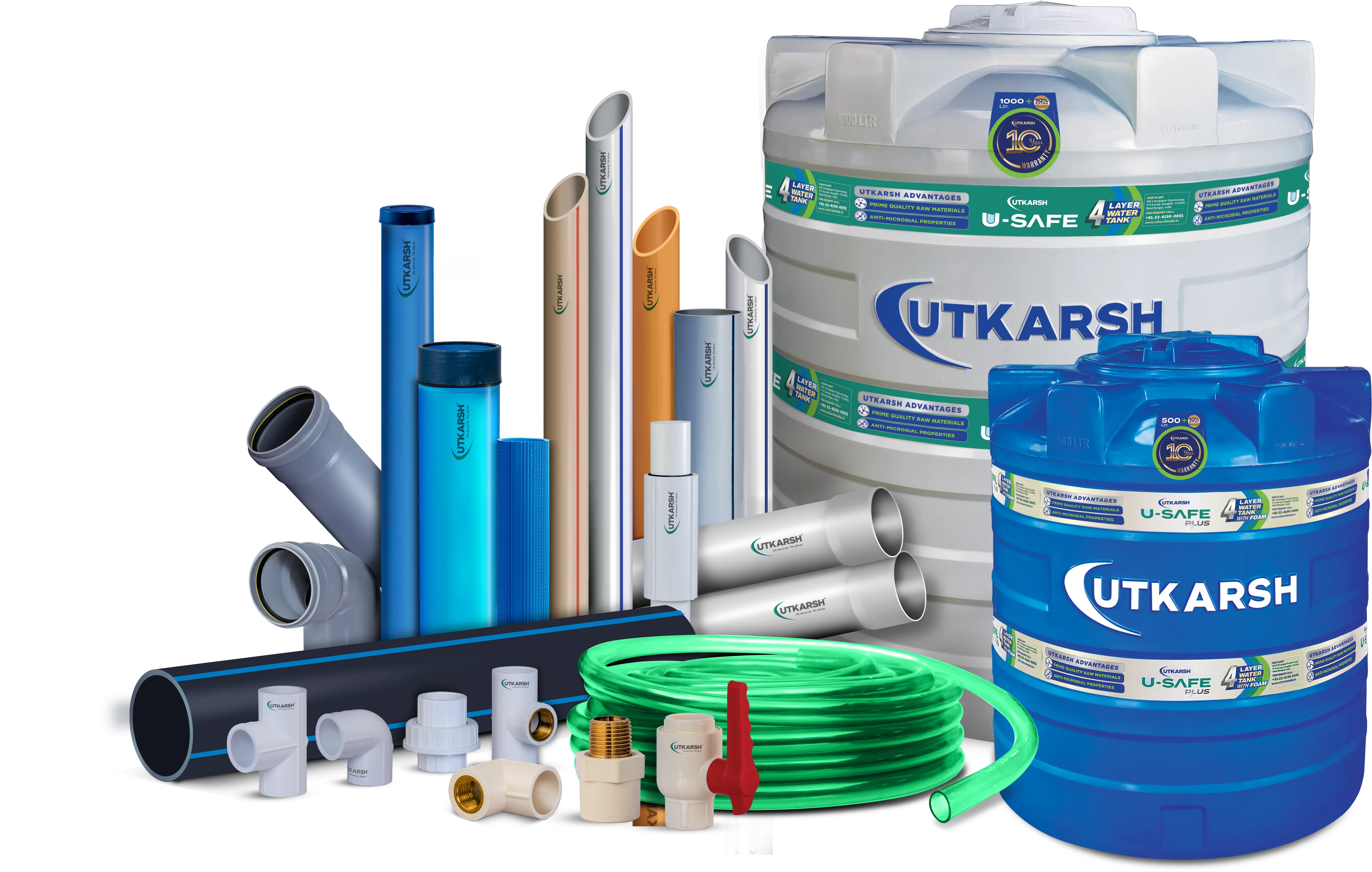
JJM's pipeline network isn't built from one material. It draws on an entire basket of piping systems, each doing a specific job in the chain from source to household tap:
UPVC pipes dominate cold water supply lines. They're light, corrosion-proof, and far cheaper to install than metal, which is why UPVC ranks among the top categories for PVC pipe manufacturers in India, with capacity ramping up steadily to meet rural cold-water distribution demand.
CPVC pipes handle hot water lines, treatment plant piping, and industrial-grade fluid handling where temperature resistance matters. Anywhere JJM infrastructure touches heated or chemically treated water, CPVC gets the call.
HDPE pipes take on the rough stuff: underground mains, high-pressure trunk lines, and terrain that would snap a rigid pipe in half. They're flexible, tough, and built for decades of underground life.
SWR pipes manage the drainage and wastewater side of rural infrastructure, keeping sewage and stormwater channeled away from drinking water sources, a quiet but critical part of any water security plan.
Agriculture pipes support the irrigation networks that often get built alongside village water schemes, since rural water infrastructure rarely stops at the kitchen tap.
PVC casing pipes protect borewells, which remain the backup or primary source for many JJM connections in groundwater-dependent regions, preventing contamination and bore collapse.
Column riser pipes carry water up from submersible pumps inside those borewells to the surface, feeding straight into the distribution network above ground.
Remove any one of them and the system fails: a cracked casing pipe contaminates a borewell, a weak riser can't lift water to the surface, a poor UPVC line leaks before it reaches the tap. JJM promises the best pipe network for rural India, and that promise can only hold up with pipes built to a genuinely reliable standard.
Also read: Quality Standards Followed by Industrial Pipe Manufacturers in India
Who Actually Benefits
A pipe manufacturing company with the right certifications, IS standards, ISO compliance, consistent quality, is sitting on a multi-year opportunity here. State water boards and PHE departments aren't looking for the cheapest bidder anymore; repeated pipe failures in earlier rural schemes taught them that lesson the hard way. They want manufacturers who can supply at scale without cutting corners on wall thickness or pressure ratings.
That shift favours established, quality-first pipe manufacturers in India over fly-by-night suppliers chasing a one-time tender. It's less about who can quote the lowest price and more about who can guarantee a pipe that's still leak-free a decade from now.
The Bottom Line
Jal Jeevan Mission has quietly turned pipes into one of India's most strategically important manufacturing sectors. UPVC, CPVC, HDPE, SWR, agriculture pipes, PVC casing pipes, and column riser pipes aren't just plumbing materials anymore; together, they're the infrastructure backbone of a national promise to reach every rural tap by 2028.
For a brand that's spent decades manufacturing precisely these products, UPVC, CPVC, HDPE, SWR, agriculture pipes, PVC casing pipes, column riser pipes, and everything that keeps water moving safely from source to home, this is exactly the kind of national mission worth being part of. It offers ISI-certified solutions across this entire range, built for real infrastructure demand. Whether you're a contractor, distributor, or project planner working on water supply infrastructure, it's worth talking to a manufacturer built for the long haul. Explore Utkarsh Pipes' UPVC pipes range to see how quality piping is powering India's water security push.
FAQs
Why does the Jal Jeevan Mission matter to India's pipe industry?
JJM is a central government scheme aiming to give every rural household a functional tap water connection. It requires massive volumes of pipes, tanks, and treatment infrastructure, creating sustained demand for pipe manufacturing companies across India.
Which type of pipe is best suited for JJM's water distribution network?
It depends on the application: UPVC for cold water supply lines, CPVC for hot water and treatment plant piping, and HDPE for underground trunk lines and high-pressure sections. Most JJM projects use a combination of all three.
How long will the demand from the Jal Jeevan Mission last?
JJM has been extended to December 2028 under JJM 2.0, with a significantly increased budget outlay. This gives pipe manufacturers multi-year revenue visibility rather than a short-term spike.
Are UPVC and CPVC pipes safe for drinking water supply?
Yes, when manufactured to IS standards and ISI-certified, UPVC and CPVC pipes are approved and widely used for potable water supply across residential and rural infrastructure projects in India.