















Water-Efficient Farming Practices for Indian Agriculture
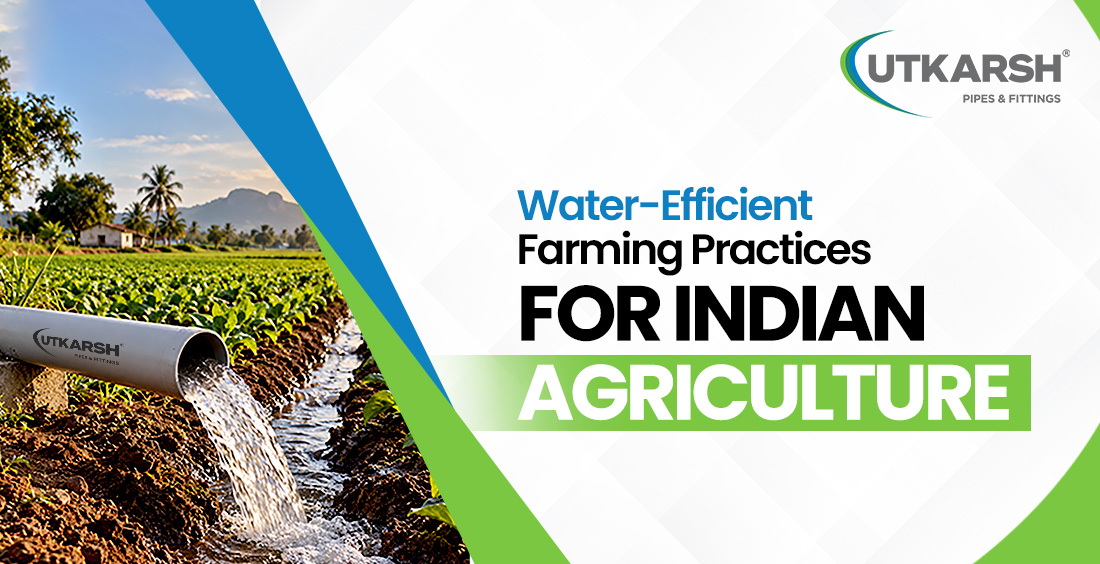
Water management is the biggest challenge for modern Indian farmers. Rainfall is often erratic, and groundwater levels are dropping fast. To keep farming profitable and eco-friendly, adopting water-efficient farming practices is essential.
The right irrigation strategy depends on high-performance infrastructure. Premium agriculture pipes and fittings carry every drop of water safely from the source straight to the crop roots.
Smart Irrigation and Soil Moisture Management
1. Drip Irrigation Systems
Drip irrigation applies water right to the root zone of the plant. This method cuts down evaporation loss and prevents weed growth between crop rows. Feeder mainlines use rigid uPVC or HDPE pipes to maintain constant water pressure to ensure every emitter receives an equal supply.
2. Sprinkler Irrigation Systems
Sprinkler systems mimic natural rainfall, making them ideal for groundnuts, pulses, and vegetables. Portable, lightweight PVC pipes with quick-fit joints make moving sprinklers across different fields fast and simple.
3. Soil Moisture and Crop Water Management
Smart irrigation relies on proper soil moisture management. Mulching, organic manure, and digital sensors help retain soil water. Farmers can schedule watering cycles accurately, avoiding overwatering while keeping crops healthy.
4. Rain-Fed Agriculture Solutions
In rain-fed areas, rainwater harvesting ponds store monsoon runoff. High-capacity pressure pipes transport this captured water during dry periods, turning unpredictable weather into a reliable water reserve.
Also Read: How Quality Agriculture Pipes Reduce Water Loss in Farming
How Pipes Are Engineered for Agricultural Use
Not all farm pipes are built the same. Agricultural piping systems must endure harsh outdoor conditions while running reliably for years. Understanding how pipe selection impacts Irrigation efficiency helps farmers match system requirements with the right pipe standards. Utkarsh Pipes & Fittings manufactures grey uPVC agricultural pressure pipes according to the strict IS 4985:2021 standards using top-grade PVC resins sourced directly from Japan.
Precision Color-Coding and Pressure Ratings
Selecting the right pipe for specific field depths or elevation changes is crucial. Utkarsh pipes feature a systematic color-coding standard by pressure class:
Key Technical Specifications & Engineering Strengths
Thermal Endurance: Engineered to withstand service temperatures up to 82°C to 90°C, preventing deformation under intense direct sunlight.
Corrosion & Chemical Resistance: Highly resistant to acidic and alkaline soils, making them ideal for handling fertigation and liquid farm chemicals without degrading.
Smooth Inner Surface: Smooth interior walls prevent mineral scaling, maximize water flow velocity, and reduce pump electricity consumption.
Flexible Joint Options: Supplied in standard 6-meter lengths with plain-end or socketed options, allowing quick installation using solvent cement welding or push-fit rubber ring joints.
Ground Dynamics Resilience: Precision joints absorb thermal expansion, contraction, and subtle ground movement during farming operations.
Building Sustainable Farms with Utkarsh Pipes
Utkarsh Pipes & Fittings brings over 50 years of manufacturing excellence to Indian agriculture. Supported by 44000 Sq. M. plant, a 68,000 MT annual production capacity, and 5,000 Tons of ready stock, Utkarsh delivers nationwide reliability.
Manufactured under strict IS, EN, and BIS standards, Utkarsh products feature a 5X Advantage: maximum durability, leak-proof performance, non-toxic raw materials, pressure tolerance, and heavy-duty structural strength. Trusted by thousands of farmers, Utkarsh provides reliable piping solutions that conserve water, reduce energy bills, and maximize crop yields.
Frequently Asked Questions
How do high-quality agriculture pipes and fittings prevent water loss in farm fields?
Precision-molded socket joints and solvent-welded fittings eliminate joint seepage and line bursts, ensuring every drop reaches the crop without distribution losses.
Which pressure class of uPVC pipe is best for micro-irrigation feeder lines?
Class 2 (Blue code, 4.0 Kgf/cm²) and Class 3 (Green code, 6.0 Kgf/cm²) pipes are ideal for drip and sprinkler systems to manage pressurized water flow without scaling or bursting.
Can uPVC agricultural pipes withstand harsh sunlight and soil chemicals?
Yes, premium uPVC pipes made with UV-stabilized compounds and Japanese PVC resins resist UV degradation, aggressive soil chemistries, and fertilizers used during fertigation.
Why is smooth interior design critical for crop water management?
A smooth inner bore minimizes friction head loss, allowing water to flow at maximum velocity across long distances while lowering the electricity needed to run pump sets.