














How Jal Jeevan Mission Is Reshaping Rural Water Infrastructure
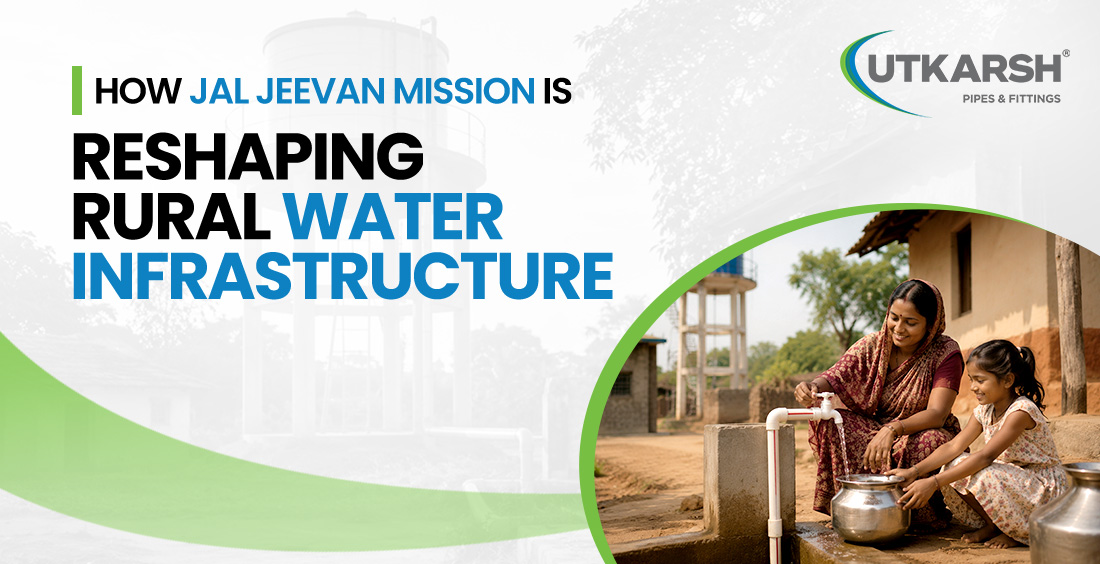
Access to clean, reliable tap water was historically a daily struggle for millions of rural Indian households. Families spent hours retrieving potable water from distant ponds, wells, or hand pumps. Launched in August 2019 under the Ministry of Jal Shakti, the Jal Jeevan Mission (JJM) – Har Ghar Jal was designed to eliminate this burden.
The mission’s target is direct and ambitious: providing 55 litres of potable tap water per capita per day (LPCD) to every rural household across India. From a modest coverage of ~16.7% (3.23 crore homes) in 2019, JJM has expanded tap water supply to over 81.8% of rural households (more than 15.8 crore homes).
This infrastructure shift requires heavy-duty distribution networks capable of surviving harsh soils, fluctuating water pressure, and varied topographies. Modern, durable piping systems serve as the core of this transformation.
Also Read: Jal Jeevan Mission and Its Impact on India's Plastic Pipe Industry
The Scale of India's Water Sector Reforms
The Jal Jeevan Mission represents a structural overhaul of India's water sector reforms. Beyond laying distribution lines, JJM integrates source sustainability, groundwater recharge, graywater management, and decentralized rural sanitation and water access.
Executing this nation-wide water infrastructure development demands rigid material standards. Pipelines installed under JJM are expected to operate reliably for decades without structural failure, chemical leaching, or scale buildup. As a result, polymer piping solutions, such as HDPE and PVC variants have replaced traditional, corrosion-prone metallic pipes across rural distribution networks.
Core Piping Solutions Powering Rural Water Networks
Building a long-lasting rural drinking water supply relies on matching specific piping materials to the unique demands of each stage of the water flow—from extraction to final consumption.
1. HDPE Pipe for Water Supply
High-Density Polyethylene HDPE pipe for water supply is the primary material used for long-distance water transmission, riverbed intake lines, and rugged terrain distribution networks.
Flexibility & Soil Resistance: High flexibility allows HDPE to absorb ground movement, seismic shifts, and dynamic traffic loads without cracking.
Leak-Proof Fusion: Heat-fused joints form a continuous, monolithic pipe string, removing mechanical joints where leaks usually develop.
Zero Corrosion & Tuberculation: Smooth inner walls eliminate friction losses and scale formation, maintaining consistent pressure across multi-kilometer stretches.
2. Agricultural Pipe Systems
Water access directly impacts rural agricultural productivity. Dedicated agricultural pipe systems handle raw water transport from borewells, canals, and farm ponds to storage reservoirs and crop fields.
High-pressure tolerance for deep-well submersible pumps.
UV-stabilized formulations to prevent degradation under direct sunlight.
Resistance to agricultural chemicals, fertilizers, and acidic soils.
3. SWR Pipes
Clean water supply requires effective waste and greywater management to protect nearby water tables from contamination. SWR (Soil, Waste, and Rainwater) pipes handle this aspect of rural sanitation.
Hygiene Protection: Facilitates leak-free transport of domestic wastewater away from habitations.
Chemical & Microbial Resistance: Prevents microbial growth and tolerates household chemicals.
Ring-Fit Joints: Rubber ring-seal joints ensure long-term, leak-proof performance under soil movement.
4. PVC Pipes Range
Unplasticized PVC (uPVC) and Chlorinated PVC (cPVC) pipes form the secondary distribution grid, transferring water from village overhead tanks directly to household taps.
uPVC Pipes: Used for main distribution lines and cold-water connections due to high tensile strength, rigid structure, and cost efficiency.
cPVC Pipes: Resistant to higher temperatures and pressure spikes, ideal for indoor household plumbing.
Lead-Free Formulations: Ensure potable water remains free of chemical contamination, satisfying strict health and safety guidelines.
Get more insights on: Pipe Selection Checklist for Residential Construction Projects
Conclusion
The Jal Jeevan Mission is fundamentally reshaping India's plastic pipe industry, turning everyday plumbing into the infrastructure backbone of a national movement. With the extension to JJM 2.0 through December 2028 and a revised total budget of ₹8.69 lakh crore, the demand for high-performance, durable piping networks is guaranteed for years to come. From long-distance main trunk lines to household tap connections, every stage of this transformation relies on proven materials, whether it is robust HDPE pipes for challenging terrain, versatile uPVC and cPVC for clean drinking water distribution, specialized SWR pipes for rural sanitation, or durable agricultural, casing, and column riser pipes to protect and lift raw water sources. State departments and EPC contractors are no longer sacrificing quality for cost; the focus has firmly shifted toward certified, long-lasting products that can withstand decades of real-world operational stress.
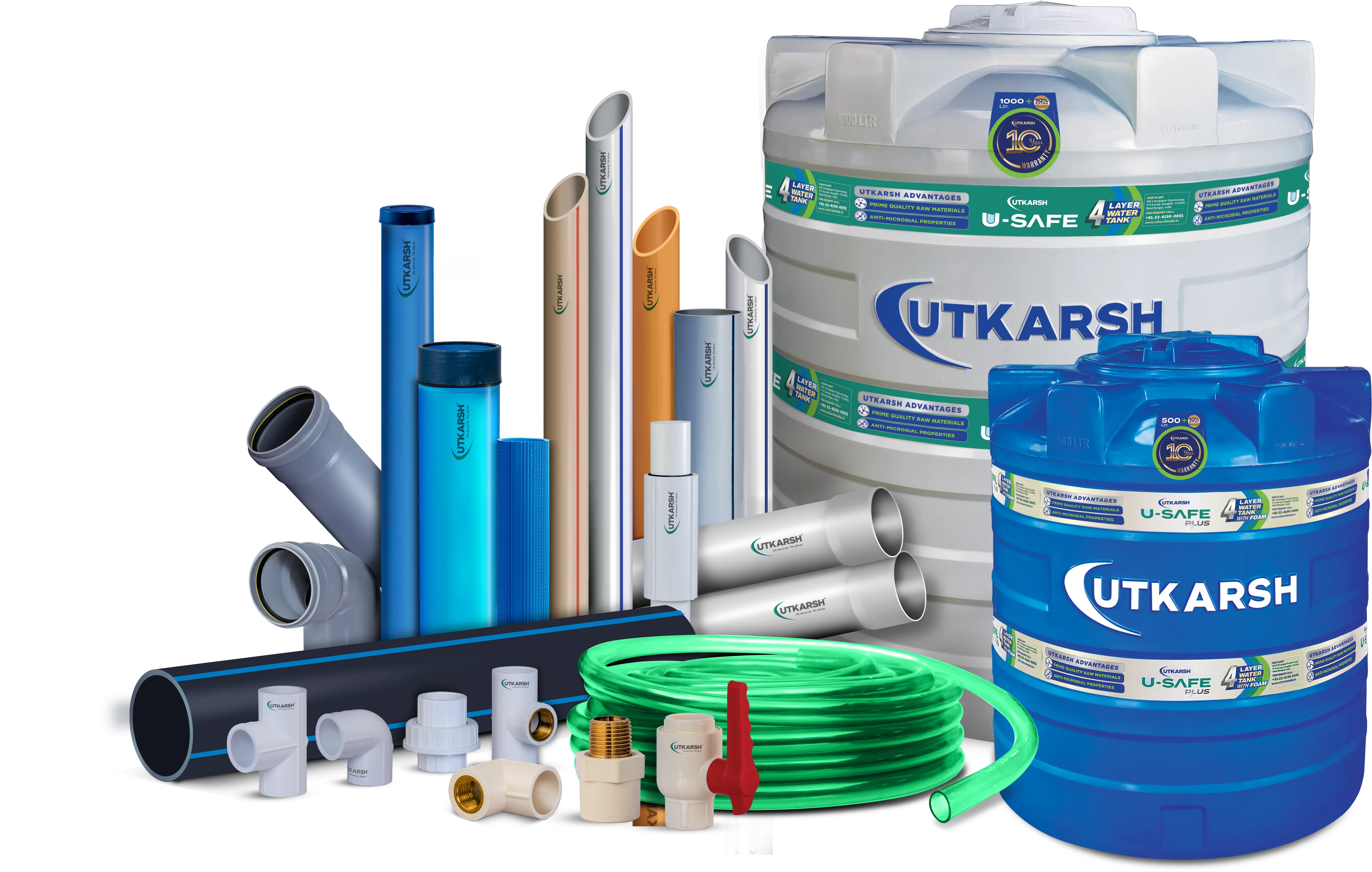
As one of the trusted pipe manufacturing companies in India, Utkarsh Pipes & Fittings is proud to engineer the solutions powering this shift. Manufacturing a complete range of ISI-certified pipe systems, including HDPE, uPVC, cPVC, SWR, Agricultural, PVC Casing, and Column Riser pipes, Utkarsh Pipes delivers the exact material standards, structural integrity, and multi-decade reliability required for large-scale water distribution projects. Whether you are a contractor, infrastructure developer, distributor, or project planner building India's water security, align your projects with a partner built for the long haul.
Frequently Asked Questions
What is the primary objective of the Jal Jeevan Mission?
The Jal Jeevan Mission (JJM) aims to provide functional household tap connections (FHTC) delivering 55 liters of safe, potable water per capita per day to every rural household across India.
Why is HDPE pipe preferred for rural water supply transmission lines?
HDPE pipe is highly flexible, corrosion-resistant, and jointed using heat-fusion techniques. This creates a leak-proof pipeline that tolerates soil movement, ground shifts, and uneven terrain without cracking.
What role do SWR pipes play in rural infrastructure?
SWR (Soil, Waste, and Rainwater) pipes carry domestic wastewater and rain runoff safely away from living areas. This prevents ground contamination, protects local water sources, and maintains hygiene standards across rural communities.
How do uPVC and cPVC pipes differ in rural water supply systems?
uPVC pipes are rigid, lead-free, and ideal for cold-water main supply and distribution lines. cPVC pipes are modified to withstand higher temperatures and pressure variations, making them suitable for indoor domestic plumbing.
How does Utkarsh Pipes and Fittings ensure product quality for large-scale water projects?
Utkarsh Pipes and Fittings manufactures its products using high-grade raw materials and strict quality control protocols. All pipe systems, including HDPE, PVC, SWR, and Agricultural lines are tested for tensile strength, burst pressure, and long-term environmental durability.